The emergence of syllogism and its part in reasoning ability dates back to the Aristotelian era. Aristotle had described syllogism to be an important aspect of reasoning in which he stated syllogism reasoning to be a discourse in which certain arguments or elements are differentiated to be dissimilar to normal considerations as these syllogism aspects are supposed to be. Even though Aristotle’s theory of syllogism gave a new phase to the doctrine of prior analytics and allowed thinkers to possibly debate on ideas and structures, it had some contradictions too. The concept of vaguely used terms by Aristotle such as ‘possibly’, ‘necessarily’, etc., might even often contraindicate some of his statements on syllogism reasoning as to some extent might even have been not so efficient in answering syllogism questions. This brings us to the fact of understanding what is syllogism and the aspects of syllogism reasoning.
A syllogism is a type of logical statement or premise intended on finding out the degree of truth while focusing on the mental element of figuring out deductive inferences based on two declarative sentences that are considered or supposed to be true. Syllogism reasoning based arguments is mainly based on a three-lined structure to derive the conclusion. George Boole modified and accepted Aristotle’s theory of syllogism by enhancing the model of syllogism by:
An ideal syllogism consists of three main parts:
The working of a syllogism or the concept of syllogism reasoning can be better understood by providing an example like:
Each of these vivid categories represents a different argument to derive to proceed into the conclusion. Here die is the major term, Romans are the inferior term and humans is the adjoining term. Both of the logical arguments are universal as well as the conclusion is inconclusive too. This speciality of syllogism reasoning makes it a unique ability of reasoning that has played an intricate part in a modern-day model of logic and reasoning along with the use of syllogism questions.
Syllogism Reasoning is a form of logical apprehension in which a conclusion is figured out from a set of prepositions based premises or phrases that further allows us to come out to a condition of deductive inference. Syllogism Reasoning may require the user to consider the statements to be relevant even if they are different from facts.
Various methods are available for understanding the procedure of solving syllogism questions with a proper explanation of syllogism logic and reasoning behind them.
The types of methods for apprehending syllogism reasoning and understanding syllogism through syllogism questions.
Type-1: Analytical Method
Sr no | Types of Statement | Letter used | Statement |
1 | Universal Positive | A | All men are strong |
2 | Universal Negative | E | No girl is weak |
3 | Particular Positive | I | Some rats are mouse |
4 | Particular Negative | O | Some planes are not ships |
All these types of statements used in the above table are fictitious statements that are just used for explanation. These statements may also be quite varied away from facts.
Type-2: Venn Diagram
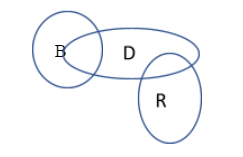
Syllogism questions can also be solved based on Venn diagrams that might be helpful to some extent for obtaining answers. These diagrams, although may not always be possible for drawing for solving every syllogism question but syllogism reasoning can be well understood.
Example:
Conclusion:
These sentences may be variant from normal facts but that’s exactly the approach for solving syllogism questions. The syllogism reasoning behind the vein diagram and the final result is that Some dwellers are bats (I to I), as the universal principle type four in the analytical method depicts(given above), that with two particular sentences only I to I is available. Therefore, only one conclusion is achievable. Nothing else is considered.
Extra syllogism question based on syllogism reasoning and principles
Syllogism questions are an effective way to understand the concept of syllogism for better understanding and knowledge grasp.
1) Find the possible conclusion among the two inferences.
Statements:
No bird is a dweller.
Some birds are flyers.
Conclusions:
The possible conclusion among both will be Flyers that are birds are not dwellers. This reference can be better understood by the illustration of the Venn diagram below.
The important aspects of syllogism are tried to be covered in the following article with a possible utility of syllogism reasoning and the necessities required to solve syllogism questions. The vital importance and emergence of syllogism theories have also been mentioned quite briefly.


 Profile
 Settings
 Refer your friends
 Sign out