The river Godavari is one of India’s most sacred rivers. It is known to be ranked as the second-longest river in India. It is also ranked as the third-largest river in India. The river Godavari system starts to flow from Maharashtra and through the states of Andhra Pradesh, Chhattisgarh, and Odisha and finally drains into the Bay of Bengal. The other states that the Godavari river grazes are Karnataka and Puducherry. It occupies a total area of about 3,12,812 square kilometres. The length of this river is measured at 1456 km long until it falls into the Bay of Bengal. The place near the origin of the river is said to have housed Rama during his exile. The river Godavari is the biggest east-flowing peninsular river in India.
This section will highlight the important features of the Godavari.
This section will highlight the states in which this river flows and the course of this river.
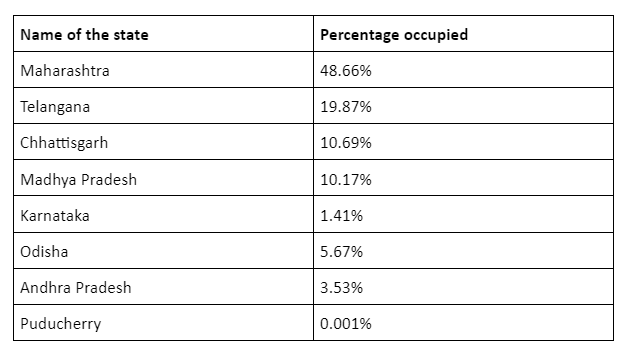
The table shows the percentage of the Godavari river that flows through the following states.
This river passes through the Deccan Plateau from the Western to the Eastern Ghats. The river then flows in a southeast direction across the south-central states of India. After moving for almost 1,465 kilometres in the southeast direction, it reaches the Bay of Bengal. At the location of Rajahmundry, which is 80 km from the coast, this river splits into two streams. They are the Gautami Godavari in the east direction and Vahshita Godavari in the west direction. This forms a very fertile delta here before falling into the Bay of Bengal.
This river basin is further divided into 3 parts
The Godavari embodies two types of tributaries. They are:
In total there are 12 tributaries of the Godavari river. The shape of the delta formed by this river is a lobate type that has a round bulge with many tributaries.
The left bank type of tributary is much larger compared to the right bank type of tributary.
Some of the important tributaries are explained below.
Right bank tributaries
The Godavari Basin gets about 85% of rainfall annually from the southwest monsoon. The southwest monsoon begins in July and ends by September. The annual rainfall ranges from 1000-3000mm. The average annual rainfall in this river basin is 1096.92 mm.
The Godavari has a lot of cultural importance associated with it. It is known as the sister to the river Ganga. This river is well-known by another name, that is the Dakshin Ganga. Nashik is an important and religious place not only because of the birth of Dakshin Vahini Ganga but also because it has a deep connection with the Ramayana. It is believed that Lord Rama has resided here for 14 years in his Vanavasa.
This article focuses on The Godavari river. The river Godavari is known to be one of the most sacred rivers in India. It is ranked as the second-longest river in India. This river is considered to be the biggest east-flowing peninsular river in India. The Godavari has a length of 995 km and a breadth of 583 km. In total there are 12 tributaries of the Godavari river. This river basin is further divided into three parts-upper, middle, and lower basin. The annual rainfall ranges from 1000-3000mm. The average annual rainfall in this river basin is 1096.92 mm. Nashik is an important and religious place not only because of the birth of Dakshin Vahini Ganga but also because it has a deep connection with the Ramayana. It was believed that Lord Rama has resided here for 14 years in his Vanavasa.


 Profile
 Settings
 Refer your friends
 Sign out