The surroundings around us are made up of different elements, compounds, or mixtures. Elements are substances whose molecules are made up of identical atoms. Scientists classified elements further into three types:
In this article, we will learn about some important and interesting facts about metals and their physical and chemical properties, along with their types and uses.
Metals are naturally occurring substances found beneath the Earth’s surface. They are lustrous and good heat conductors. A metal is a material found naturally under the surface of the Earth. They are classified into different forms and types. They are hard and wire and can be formed into sheets. Metals lose valence electrons to form positively charged ions or cations. Gold, silver, iron, copper, aluminium, magnesium, calcium, sodium, and platinum are a few examples of metals.
Metal is hard. It is not the case with potassium and sodium. They both are delicate and can be easily cut with the help of a knife or blade.
Metals tend to produce sounds when they get striked. They are sonorous.
The property of metals can be battered into thin sheets. This is termed or referred to as malleability.
Metal has a ductile property. A wire is formed when it is pulled via a hole.
Metals are rich in high density. However, lithium, Potassium and Sodium have a lower density compared to water. Hence, they are considered as an exception.
Under ordinary temperatures, metals tend to remain solid. But, it is not the same with gallium and mercury. They are in a liquid state in the room or at normal temperature.
A metal is a good conductor of electricity. However, in this case, Lead is an exception. It is neither a good conductor of electricity nor heat.
Newly cut or cleaned metals mirror rich light without sparkling and the metals look radiant.
A metal is a good conductor of heat. Aluminium, Copper and silver are bad conductors of heat.
Metals have a high melting point and boiling point except for metals like sodium, potassium, mercury, and gallium.
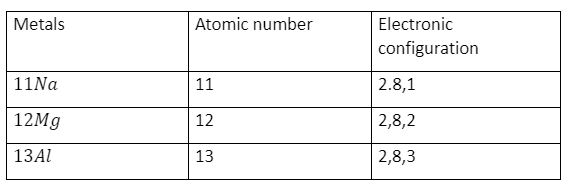
The electronic configuration is the basis of the chemical behaviour of elements. For example, most metals have up to three electrons on their furthest shell.
Metals have a tendency to lose their valence electrons to form positively charged ions, that is, cations.
Na →Na+ + e-
(2,8,1) (2,8)
Sodium Sodium ion
Mg → Mg+++ 2e-
(2,8,2) (2,8)
Magnesium Magnesium ion
Al→ Al+++ + 3e-
(2,8,3) (2,8)
Aluminium Aluminium ion
Metals combine with oxygen to combine oxides.
Metals + Oxygen ———-> Metal Oxide
The metal oxides are basic in nature. Metal oxides react with an acid to form salt and water.
Metals oxide + Acid ———–> Salt + Water
Most of the metals react with dilute acids to form metal salts while hydrogen gas is released.
Metal + dilute Acid ————–> Salt + Hydrogen gas
Most metals have no observable and rapid reaction with cold water. However, some metals, such as sodium and potassium, react with cold water to produce hydroxides and hydrogen gas. Similar reactions require steam in the case of magnesium metals.
Since metals are bendable, aluminium is extremely well known for shaping exceptionally thin sheets. It is used for bundling.
Metals are formed naturally beneath the Earth’s surface. They are lustrous and have excellent heat and electricity conductors. Metals are lustrous. They have a high degree of malleability and ductility. Metals have numerous applications and are used all over the world.


 Profile
 Settings
 Refer your friends
 Sign out