A vector is a physical quantity with a magnitude and a direction associated with it. Vectors can have different notations like Matrix notation, Cartesian notation, and Polar notation. There are many cases where we use the benefit of symmetry of a given structure, for example, spherical symmetry or cylindrical symmetry. Now, let’s talk about different types of vectors:
Then we can write
A=B+C=C+B
That means vector additions are commutative.
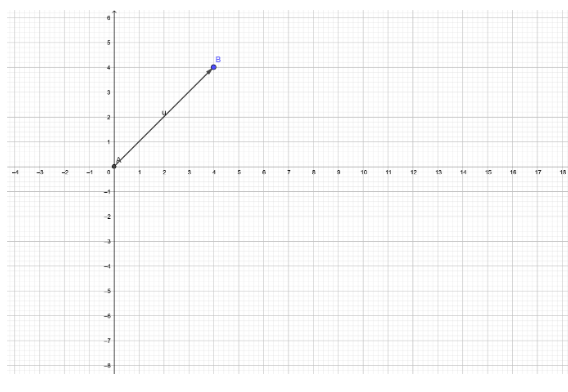
As a sum of two vectors- The notation of a vector is given by an arrow. The tail of this arrow represents the initial point, and the tip of the arrow represents the final point of the vector.
In the above diagram, we have a vector u which is shown.
In order to write a vector, we need base vectors which are unit vectors and called basis.
For two dimensions, we need two bases, along x it is I, and along Y it is j.
For example, in the given figure, we can write
u = 4i +4j
We can write,
u=4 4 0 where 0 represents no component in the z-direction.
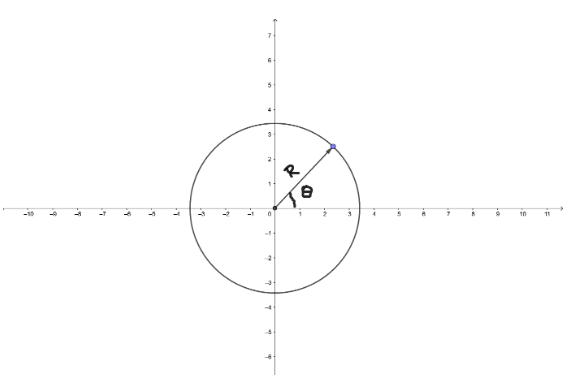
In the given figure, the vector R can be written as
R = (R, θ)
A.B=AB cosθ
AB=ABsin n
Where n is a unit vector perpendicular to the plane of A and B
Similarly, for three dimensions, we have
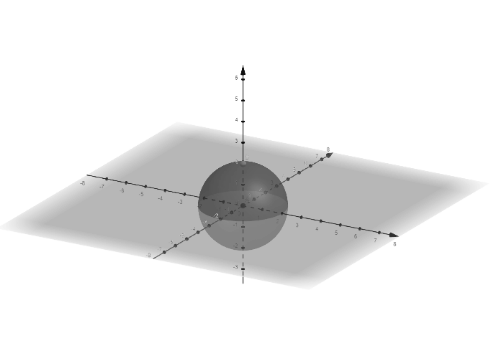
u=xi+yj+zk (in Cartesian form)
This vector represents any point on the surface of the sphere.
Having magnitude,
x2+y2+z2=u2
u=(r,θ, ϕ) (in polar system)
Where,
theta is the angle made by the projection of the R vector on the x-y plane with the positive x-axis, and r is the radial distance.
ϕ is the angle made by the vector from the z-axis.
Vectors remind us of the importance of direction. If we are applying a force on any object, we have to be clear about the direction of using that force. Although we can move a vector freely through space, some vectors cannot be movable like fixed vectors.
Since there are a lot of mathematical tools available for vectors and matrices, we have the advantage of having this branch in physics.
Vectors in two dimensions have two components and in three dimensions have three components. We can resolve every vector in the direction of their basis. In two dimensions, we have two bases perpendicular to each other, but it is not necessary that the basis must be perpendicular. They may or may not be perpendicular.



 Profile
 Settings
 Refer your friends
 Sign out