In everyday life, we all are prone to being exposed to electromagnetic fields. These are produced in our day-to-day appliances like mobile phones, radio transmitters, electronic appliances, etc. The most common proof – a mobile phone has a touch screen feature and computers have touch pads. These come under the most widely used ‘touch’ called the capacitive touch. And a capacitor is all about electric fields. Also, wherever there is a presence of a magnetic field, an electric field is also present.
It is the algebraic vector addition of all the electric fields caused at the point due to individual charges.
In other words, the total field is a vector sum of all charges.
Electric field intensity due to n charges at a given point can also be explained as the force that a unit positive charge would experience at that point.
What is an electric field?
In simple words, an electric field line is a path that a positive charge would follow when it is allowed to be free. Electric field is a characteristic of electric charge correlated to a point in free space when charge is present. Electric fields are mainly of two types, that is, uniform electric field and non-uniform electric field. Its SI unit is volt per metre (V/m).
Michael Faraday, an English physicist, was the first to discover the theory and hypothesis of the electric field and its various properties and applications.
What is a point charge?
It is a charge having negligible mass and no dimensions.
Definition: Electric field is the region around the charge particle within which the other charges experience the force of attraction or repulsion.
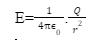
Magnitude of electric field :
The electric field induced around the unit charge is given by:
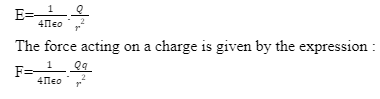
The force acting on a charge is given by the expression :
Where q and Q are point charges,
r is the distance between these charges, and
0 is permittivity of the vacuum.
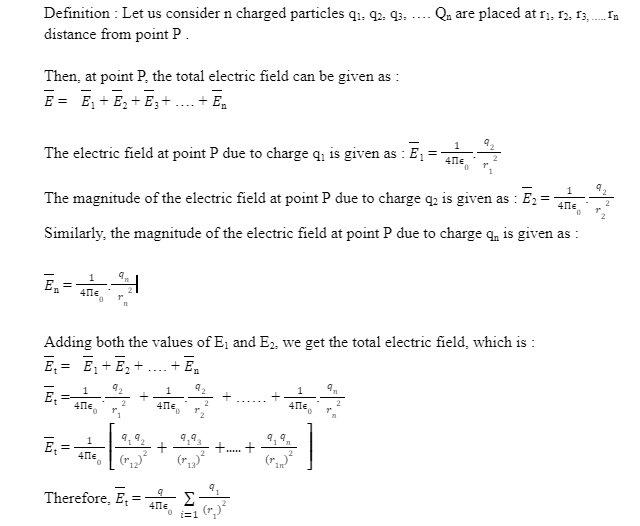
What is the electric field due to a system of charges ?
It is the algebraic vector addition of all the electric fields caused at the point due to individual charges.
In other words, the total field is a vector sum of all charges.
Electric field intensity due to n charges at a given point can also be explained as the force that a unit positive charge would experience at that point.
Derivation of electric field due to system of charges
Electric field due to dipole
A system of two unlike charges having some magnitude and which is kept at some fixed distance is said to be a dipole.
In other words, two charges that are equal in magnitude but opposite in polarity are separated by a distance between them. It is a vector quantity and has an SI unit of coulomb metre.
Equation:
P = q x l where p= dipole, q=charges kept and l= distance the charges are kept at.
What is a dipole moment?
The length or measurement of these positive or negative charges separated by a distance is called a dipole moment.
Properties of electric field lines :
Electric field lines are just imaginary field lines that can never intersect each other.
The relative closeness of the field lines gives the idea of the strength of the electric field. Field lines are stronger when congested and weaker when they are far apart.
The tangent to the electric field lines is in the direction of the electric field at that point.
The field line is directly proportional to how much charge is stored in a particle.
The field line starts from positive charge and ends at a negative charge.
The line curves are a charge-free region.
They can pass through a non-conductor, but cannot pass through a conductor.
Conclusion
In simple words, an electric field line is a path that a positive charge would follow when it is allowed to be free. Electric field is a characteristic of electric charge correlated to a point in free space when charge is present. Electric fields are mainly of two types, that is, uniform electric field and non-uniform electric field. Its SI unit is volt per metre (V/m).
Electric field is the region around the charge particle within which other charges experience the force of attraction or repulsion.
Magnitude of an electric field :
The electric field induced around the unit charge is given by:



 Profile
 Settings
 Refer your friends
 Sign out