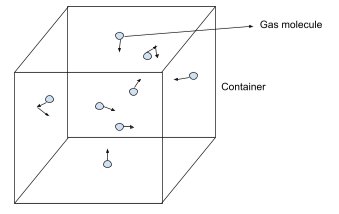
This article will mainly discuss the 5 postulates of the Kinetic theory of gases. We will also get an answer to the question, “What are the three main points of the Kinetic theory of gases?”. But first, we need to understand what is meant by the kinetic theory of gases.James Clerk Maxwell, Rudolf Clausius, and Ludwig Boltzmann developed the Kinetic theory of gases. This theory tries to explain the macroscopic properties in terms of the motion of the molecules present in it.What is the Kinetic theory of gases?The Kinetic Theory of Gases states that the gaseous particles will be in a constant motion and undergo perfectly elastic collisions. And also, average kinetic energy will be proportional to absolute temperature.
What are the three main points of the Kinetic theory of gases?
The following are the three main points of the Kinetic theory of gases.
When molecules collide, there is no loss or gain of energy
The molecules in a gas take up little space in relation to the container they are in
The molecules are always moving in a straight line
Before we move on to our following discussion, we need to understand the difference between assumption and postulate.Assumption: A statement which is accepted as accurate without any proof.Postulate: A postulate is an assumption used to prove other statements.
Assumptions of Kinetic theory of gases:
Following are the assumptions of the Kinetic theory of gases.
Gas molecules are constantly moving in random directions
Gas molecules travel in a straight line
Gas molecules are tiny compared to the distance between them, and the volume of the molecules is negligible
Average Kinetic energy is dependent on absolute temperature
During the random motion of molecules, there will be elastic collisions
The motion of gas molecules is based on Newton’s laws of motion
The time interval of collision between any two molecules is minimal
5 Kinetic theory of gases:
This is also known as the postulates of the Kinetic theory of gases. Following are the 5 postulates of the Kinetic theory of gases.
Gas is made up of numerous molecules that move at random
Intermolecular interactions are negligible
Collisions between molecules and between molecules and container walls are always elastomeric
The average kinetic energy of all molecules is temperature-dependent
Gas molecules are tiny compared to the distance between them, and the volume of the molecules is negligible
Factors affecting the behaviour of gas molecules:
Temperature(T)
Volume(V)
Pressure(P)
Number of molecules(n)
Formulas based on Kinetic theory of gases:
There are few formulas which are obtained from Kinetic theory of gases and few of them are as follows.
Total Kinetic energy of the gas:
Total kinetic energy of the gas molecules can be found using the below formula.K.E = 3/2nRTHere,K.E is the Kinetic energyn is the number of molesR is the universal gas constantT is absolute temperature
RMS Speed:
It is the average velocity of the gas molecules. It can be calculated using the below formula.Vrms = 3RTMHere,Vrmsis the root mean square speedR is the universal gas constantT is absolute temperatureM is molar mass
Boltzmann constant:
We have used Boltzmann constant in solving various problems, but how is it obtained?Below is the formula which is used to find Boltzmann constant based on Kinetic theory of gases.k = nRNHere,k is Boltzmann constantn is the number of molesN is Avogadro numberR is the universal gas constant
Pressure of gas:
Pressure of gas can also be obtained based on the kinetic theory of gases, and below is the formula.P = 1/3Vrms2Here,P is the pressure is the densityVrmsis the root mean square velocity
Applications:
All ideal gas laws are proven by the kinetic theory of gases. Following are the ideal gas laws.
Boyle’s law: Pressure(P) of the gas is inversely proportional to the volume(v) at constant temperature(T) i.e.P ∝ 1v
Charle’s law: Volume(v) is directly proportional to the temperature(T) at constant pressure(P) i.e.v ∝ T
Gay Lussac’s Law: Pressure(P) is directly proportional to the temperature(T) at constant volume(v) i.e.P ∝ T
Conclusion
In this article, we studied the Kinetic theory of gases and the three main points. We also saw a few assumptions made in the Kinetic theory of gases. Then we came across the postulates of the Kinetic theory of gases. We also saw a few formulas like the gas’s total kinetic energy, gas pressure, RMS speed, and Boltzmann constant, which were obtained based on the Kinetic theory of gases. At last, we saw the applications of the Kinetic theory of gases to prove the ideal gas laws.



 Profile
 Settings
 Refer your friends
 Sign out