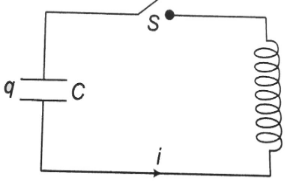
If the two conditions (series and parallel) in an electronic circuit are satisfied and the circuit is functioning correctly, then the charge flows through the circuit. The idea is that there is a flow of electrons or an electric charge flow. In this sense, the term “current” merely means that something is happening within the wires and charges are moving. As a physical measurement, it is the speed at which a charge moves through an element in the circuit. As illustrated in the figure below, the amount of current flowing through the circuit is determined by measuring the amount of charge q flowing through a wire section over the time t is assessed.
Current is a term used to describe a rate. There are many rate quantities in Physics. For instance, velocity is one of them. It is the rate at which an object alters its location. Mathematically, velocity refers to the change in position per time. Acceleration is a quantity of rate that describes the rate at which an object alters its velocity. Mathematically speaking, acceleration is the change in velocity with time. Power is the rate at which work is performed on an object. Mathematically, power refers to the ratio of work to time. In all cases of a rate number, the mathematical equation entails an amount over time. So, current could be represented as a rate number mathematically.
The current (I) = q/t
Notice that the above equation uses the letter I as a symbol to represent the current amount.
In the ordinary course of events, when a particular quantity is discussed in the Physics classroom, the most common SI unit used to define the current is used too. The most common metric unit used that measures current is ampere. Ampere is commonly reduced to Amp and is abbreviated with the symbol A. An ampere current indicates that there is one Coulomb of Charge passing through the cross-section of a wire each second.
1 ampere = 1 coulomb/1 second
The excess or deficiency of electrons in a substance is an electric charge.
q = It
q = en
Where:
q = Charge Coulombs
I = Current, in Amperes
T = time in seconds
e = the number of electrons or proton
n = charge for an electrons or proton
One coulomb represents the amount of charge that is transferred in a second by a constant current of one amp.
The same charges are always incompatible with each other, while charges with different characteristics attract each other, i.e.
Coulomb’s law can determine a force resulting from attraction, the force of repulsion among two charged particles.
FCoulomb’s = k(q)(q)r2
Where:
There are three kinds of electric charging:
When it’s been determined that the average rate of drift of electrons is very slow, the question comes up: Why is the light in a room and flashlight turned on shortly after the switch is switched on? Shouldn’t there be a noticeable delay in time before the charge carrier is transferred between the light switch and the light bulb’s filament? It’s not true! And the reason is revealing about the way that charge flows within circuits.
The charge carriers that are present in electrical circuits’ wires are electrons. The electrons are generated by atoms in copper (any other material that the wire is constructed with) inside the wire. When the switch is switched on, the circuit shuts as an electrical potential is created between the two ends of the circuit externally.
The energy stored by the charge can be exhausted (or an alternative method of saying this could be that electrical energy is transformed into different types of energy). However, charging carriers never disintegrate, disappear or disappear out of the circuit. There isn’t an area in the circuit in which charge carriers start to build up or build up. The speed at which charge flows into the circuit externally on one side is identical to what happens when it exits externally on the other side. The current-charge (electrons) flow rate is the same.



 Profile
 Settings
 Refer your friends
 Sign out