A simple Harmonic motion is back and forth motion about a fixed axis or a straight line. It can be defined as a type of oscillatory motion or periodic motion.
In SHM, the acceleration acting on the body varies directly with the displacement and is opposite to the direction of displacement. Therefore, the net force which acts on the body also varies directly with the displacement and in the direction opposite to it. A motion of a spring-mass system describes an SHM. A block suspended from a spring is termed a spring-mass system.
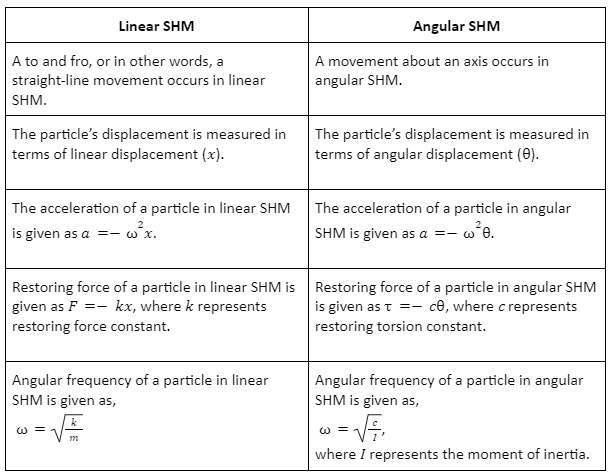
There are two types of Simple Harmonic motion-Angular and Linear.
A body is said to be in linear SHM when it moves to and fro about a mean position. A spring mass system, which is a block of mass suspended from a spring, is an example of a linear SHM.
For an SHM to be categorised as linear, it should fulfil the following conditions:
A differential equation for linear SHM can be obtained as follows:
ma=-kx
or,
a=-kx ⁄ m
a=dv ⁄ dt=d²x ⁄ dt²
d²x ⁄ dt²=-kx ⁄ m
Or,
d²x ⁄ dt²+kx ⁄ m=0
d²x ⁄ dt²+ω²x=0
Therefore, the differential equation for linear SHM can be written as
d²x ⁄ dt²+ω²x=0
A body is said to be in angular SHM when it rotates or oscillates freely about a given axis. The motion of a mass attached and suspended by a string (simple pendulum) is an example of angular SHM.
For an SHM to be categorised as angular, it should fulfil the following conditions:
A differential equation for angular SHM can be obtained as follows:
Iα=-cθ
Or,
Iα+cθ=0
a=dv ⁄ dt=d²θ ⁄ dt²
Sinceα =d²θ ⁄ dt² the equation (Iα+cθ=0) can be written as,
I d²θ ⁄ dt² +cθ=0
I d²θ ⁄ dt² +cθ=0
A simple harmonic motion can be defined as a back and forth motion about a fixed axis or a straight line. For a simple harmonic motion, the acceleration acting on a body varies directly as the displacement of the body, in a direction opposite to it. A simple harmonic motion can either be linear or angular.
Linear SHM is a to and fro motion about a straight line, while angular SHM is the motion about an axis. For a linear SHM, force and acceleration should be proportional to displacement. For an angular SHM, torque should be proportional to displacement. A spring-mass system is an example of a linear SHM, while a pendulum is an example of an angular SHM.



 Profile
 Settings
 Refer your friends
 Sign out