Electric charge can be said to be the fundamental feature of matter. It controls how elementary particles are influenced by a magnetic field or an electric field. Electric charges can neither be created nor destroyed; they exist in discrete units. Two types of electric charges exist: positive and negative. Same charges repel each other, just like the poles of a magnet, whereas different charges attract each other.
These charges come from an electron or proton in an object. Electrons and protons have the same amount of charge in them; however, they differ in their sign. This means that an electron and a proton have a negative and positive charge, respectively, of the same magnitude.
The principle of superposition is used to determine the overall force exerted on a charge by all the point charges.
The principle states that an electric charge produces an electric field around it, which is irrespective of any other particles present in that medium. The electric field produced as a result is a sum of all the electric fields produced by all the other particles present in that medium.
If we need to calculate the net field, net flux, or net potential energy within a system, we use the principle of superposition.
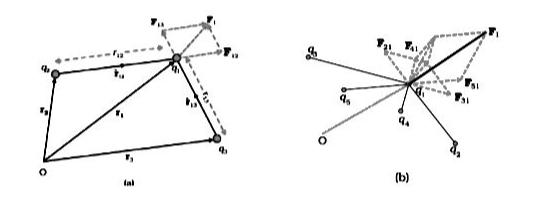
Let us consider the example of a system constituting three charges. The system is assumed to be in a vacuum. Now we need to calculate the sum of all the forces on each charge individually because of the presence of other charges in the system. This is called the principle of superposition.
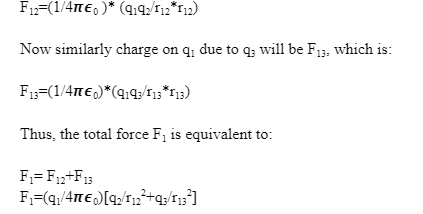
Let the force on the charge q1 be F12 exerted because of the charge q2. F12 is thus calculated as:
When we talk of discrete charges, we do not require calculus but simple mathematics to make the calculations. This is one of the reasons why we understand things with discrete charges. However, it is impossible to work with discrete charges practically, and thus one should work and understand the continuous distribution of charges. In continuous charge distribution, all the charges are bounded together with little space between one another.
There are three different ways to witness the distribution of charges. They are:
We use the principle of superposition when the charges come into play, and the force exerted on each charge has to be calculated. It works on the distribution of charges. It concludes that force is exerted on a charge in a system by all the other charges present in the system. This force is an algebraic sum of all individual force.
A limitation of this principle is that it can measure voltage but not power. It can work only for linear circuits and is inapplicable for bridge circuits.



 Profile
 Settings
 Refer your friends
 Sign out