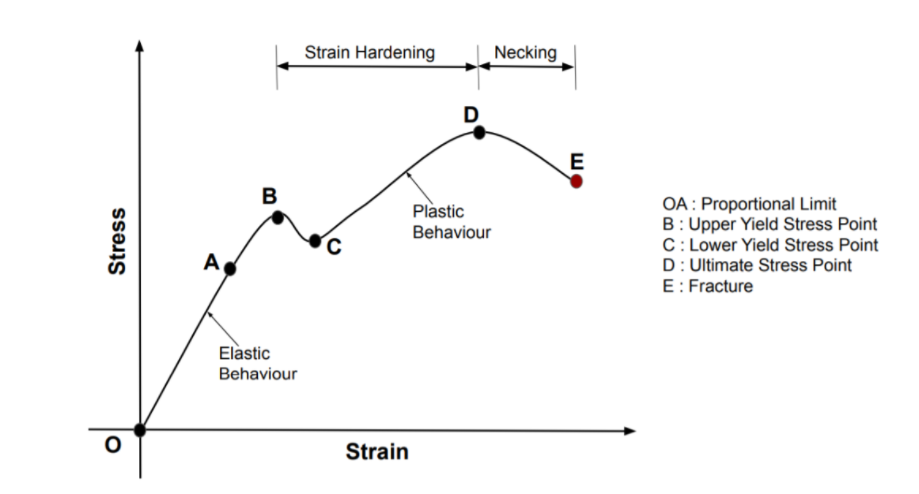
Generally speaking, angles representing the relationship between stress and strain in any form of distortion can be regarded as stress-strain angles. Stress and strain can be normal, shear, or admixture, also can be uniaxial, biaxial, or multiaxial, indeed change with time. The form of distortion can be contraction, stretching, torsion, gyration, and so on. However, stress – strain wind refers to the relationship between axial normal stress and axial normal strain of accoutrements measured in a pressure test.
Consider a bar of original cross-sectional area A0 being subordinated to equal and contrary forces F pulling at the ends so the bar is under pressure. The material is passing a stress defined to be the rate of the force to the cross-sectional area of the bar, as well as an axial extension-
σ=F/A0.
ε=L-L0/L0
=∆L/L0.
Here 0 denotes the original confines of the sample. The SI unit for stress is Nm2, and strain is unitless. Stress-strain wind for this material is colluded by protracting the sample and recording the stress variation with strain until the sample fractures. By convention, the strain is set to the x axis and stress is set to the y axis. The curve grounded on length and cross-section area is called the true stress-strain curve.
Due to the revulsion of section area and the ignored effect of developed extension to further extension
σt=FA.
εt=δL/L.
Assuming volume of the sample conserves and distortion happens slightly
A0L0=AL.
The true stress can be expressed by
σt=F/A=F/A0.
A0/A=F/A0.L/L0=σ(1+ε).
For the strain , δεt=δL/L.
Integrate both sides and apply the boundary condition,
εt=ln ln (L/L0)=In ln (1+ε).
As for the tensile strength point, it’s the minimal point in engineering stress-strain wind but isn’t a special point in true stress-strain wind. The criterion for necking conformation can be set as δF=0
δF=σtδA+Aδσt=0.
-δA/A=δσt/σt.
After this the stress and strain at the necking can be expressed as:
σt=FAneck.
εt=In ln (A0/Aneck).
An empirical equation is generally used to describe the relationship between true stress and true strain is σt
=K(σt)n here n is the strain-hardening measure and K is the strength measure.
There are several stages showing different actions, which suggests different mechanical parcels.
It is a graphical representation of the used material’s strength and elasticity and helpful to understand the behaviour of the materials.
Stress and strain have a straight proportional relationship up to an elastic limit and it is explained by Hooke’s law which states that the strain in a solid is proportional to applied stress.



 Profile
 Settings
 Refer your friends
 Sign out