Electrical resistivity (sometimes referred to as specific electrical resistance or volume resistivity) is a property of a substance that governs how well it resists electric current. Electric current can freely flow through a substance with a low resistance.The Greek letter is widely used to indicate resistance.
Formula for resistivity can be:
=RAL
is resistivity
R is resistance
A is cross-sectional area
L is length of the conductor
Furthermore,
Resistivity = 1/conductivity
= 1/σ
Resistivity is influenced by a variety of elements, including:
The material’s temperature :
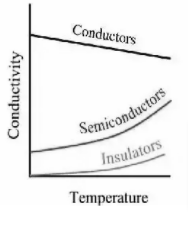
The temperature affects a substance’s resistance and resistivity. The amplitude of the vibrations of the atoms in the lattice increases as the temperature of the conductor rises. As a result, the atoms’ collision cross-section grows. The atoms then provide a larger target. This makes it more likely that they will collide with unbound electrons. As a result, the resistance of a conductor increases as the temperature rises. The changes in resistivity of a metallic conductor with temperature have been found to be linear throughout a wide range below and above 0 oC in experiments. This indicates that at 0 °C, the resistivity is not zero.
The material’s characteristics:
Variation of conductors:
Valence electrons are loosely connected to the nucleus in conductors. Because metals or conductors have a low ionisation energy, they lose electrons quickly. Delocalized electrons travel freely within the complex when an electric current is applied to it. As the temperature rises, the mobility of metal ions in the material structure increases as well. Metal begins to vibrate with a greater amplitude as it ages. As a result of these movements, many collisions between free electrons and other electrons occur. Each contact leads the free electrons to lose some energy and become unable to move freely. It prevents free electrons from moving around freely. The mean velocity of the electrons drops as they collide.As a result, the metal’s resistivity increases, and the current flow in the metal reduces. As the resistance of the material increases, the substance’s conductivity drops.
Variation of semiconductors:
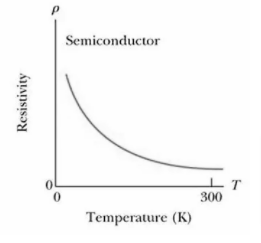
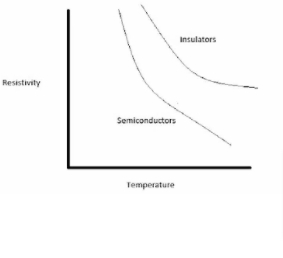
Semiconductors include materials such as silicon. The prohibited gap between the conduction band and the valence band in semiconductors is lower than in pure conductors. The valence band is filled at 0 K temperature, but the conduction band may be vacant or partially filled. The electrons easily shift to the conduction band when a modest amount of energy is applied, increasing the semiconductor’s conductivity. Semiconductors include materials such as silicon. In the lattice structure of silicon, each silicon atom is bonded to four other silicon atoms.
Variation of insulator:
The energy gap between the conduction band and the valence band in insulators is extremely large. The valence band in insulators is partially filled with electrons. The prohibited gap between the two bands will be greater than 3 eV, necessitating the use of energy to transport electrons to the conduction bands. Insulators include materials such as glass, polymers, and diamond.
A conductor’s resistance is directly proportional to its length. That is the resistance of a conductor divided by the conductor’s length.
A conductor’s resistance is inversely proportional to its cross-sectional area.That is, if the cross-sectional area of a conductor is doubled, its resistance is halved.
All pure metals’ resistance increases as the temperature rises. As the temperature rises, the resistance of alloys increases only marginally. When the temperature of a metal rises, the resistance rises, but when the temperature of a semiconductor rises, the resistance lowers.
Some materials have a low resistance, whereas others have a significantly higher resistance. In general, an alloy is more resistant to corrosion than pure metals.Copper, silver, aluminium, and other low-resistance metals have a higher resistance than nichrome, constantan, and other high-resistance metals. Heating elements for heaters, toasters, electric irons, and other appliances are made of nichrome.
Resistance is encountered by an electron moving across the wires and loads of the external circuit. The flow of charge is hampered by resistance. The travel of an electron from one terminal to the next is not a straight line. Rather, many collisions with fixed atoms within the conducting substance result in a zigzag pattern. The electrons run into resistance, which slows them down. While the electric potential difference between the two terminals favours charge transfer, it is resistance that prevents it. The combined influence of these two factors determines the rate at which charge flows from terminal to terminal.



 Profile
 Settings
 Refer your friends
 Sign out