Refraction, in physics, the change of the wave path from one medium to another due to its change in speed. For example, waves move faster in deep water than in the top. If the ocean waves approach the coast in a perpendicular direction, part of the wave farther from the sea will move faster than the nearest part, so the wave will swing and move toward the coast. The speed of sound waves is greater in warm air than in cold.
Generally refractive index, also called an index of refraction, is a measure of the bending of a ray of light as it passes from one medium to another.
If i is the angle of incident of the ray in the vacuum (the angle between the incoming ray and the perpendicular to the surface of the source, called normal) and r is the refraction angle (the angle between the ray and the normal), refractive index n is defined as the sine of the incident angle to the sine of the refraction angle; that is,
n = sin i/ sin r.
Refractive index is also determined as:
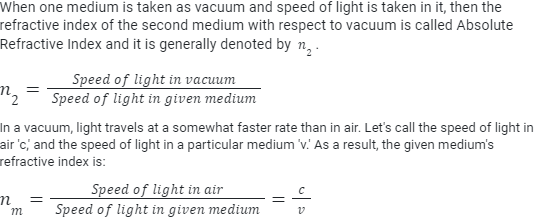
n = c/v
When light travels from one medium to another, the refractive index influences how much its path changes. This angle of refraction is explained by Snell’s law. Snell’s law is often referred to as the “Law of Refraction” or the “Snell-Descartes” Law. Snell’s Law was discovered in 1621 by Willebrord Snell.
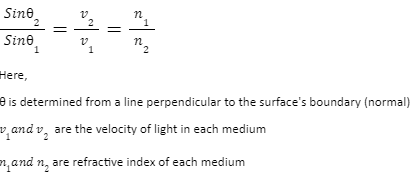
When light passes through a barrier between two mediums, it is partially refracted and partially reflected. When light flows through one medium to another, such as air, glass, or water, Snell’s law describes the relationship between the angle of incidence and angle of refraction.
The phase velocity ratio in two distinct media is the same as the sine of the angle of incidence and sine of the angle of refraction. Furthermore, it is also the same as the refraction indices ratio.
As the refractive index of a medium is the ratio of its speed of light to the speed of light in vacuum, light will travel faster in the medium with a lower refractive index.
High-refractive-index optical polymers allow light rays to bend more within the material, resulting in a smaller lens profile. In addition, when the refractive index rises, the lens’ thickness reduces, resulting in a reduction in weight.
Medium having greater value of refractive index is called optically denser medium, this means light will travel at slower speed in optically denser medium compared to in an optically rarer medium.
The speed of light is defined as the product of frequency and wavelength, according to the refractive index definition. Regardless of the medium, the frequency of the light wave remains constant. The wavelength of a light wave changes as a result of refraction. As a result, the refractive index changes as the wavelength increases.
Refractive index is also known as refraction index or refraction index. The qualities of the medium influence the speed of light in it. The speed of electromagnetic waves is determined by the optical density of the medium. The tendency of atoms in a substance to recover absorbed electromagnetic energy is known as optical density. The slower the speed of light is, the more optically dense the substance is. The refractive index is one such measure of a medium’s optical density.



 Profile
 Settings
 Refer your friends
 Sign out