Physics is all about articulating real-world values rather than memorising them. Many concepts, difficulties, and mathematical formulas may be encountered during applications. We must use our talent, ingenuity, and good sort of potential to find solutions to these problems. Physics is the study of how our universe’s fundamental parts interact. This discipline encompasses a diverse variety of sub-fields ranging from quantum physics to nuclear physics, and it is an important part of the syllabus for many competitive tests held for entrance to engineering and technical programmes. Certain physics formulae are used more frequently than others, and these are the formulas that are most useful to have on hand.
physics formulas
Some basic physics formulas are given as:
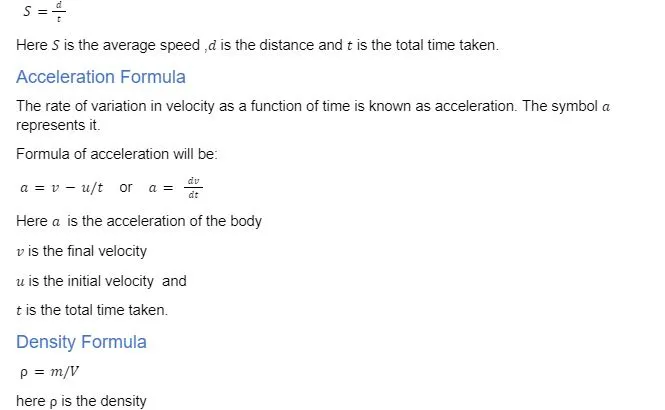
Average speed formula
It is used to determine a moving body’s average speed(S) for the distance travelled (D) as well as the time period (T).
Formula will be:
V is the volume of the body.
Above formula represents the amount of material in a certain region.
Power Formula
Energy is a term that refers to a person’s ability to execute a task. Power, on the other hand, is the amount of energy expended during a specific length of time to carry out an activity (task).
P=W/t
Here P is the power
W is the total work done and
t is the total time taken
Newton’s Second Law
F=m×a According to this law, the force can be calculated using the formula by multiplying the mass and acceleration of the body.
Weight Formula
The force that an object experiences owing to gravity is known as weight.
W=mg
Here W is the weight
m is the mass of the body
And g is the acceleration due to gravity
Pressure Formula
The amount of force exerted per unit area of the object is known as pressure.
P=F/A
P is the pressure
F is the force and
A is the area
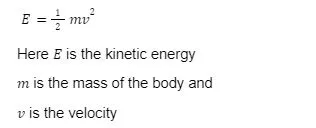
Kinetic Energy formula
It is the energy that a body possesses as a result of its motion.
Ohm’s Law Formula
According to Ohm’s law, the current flowing through a conductor material is directly proportional to the potential between two conductor ends.
V=I×R
Here V = voltage in volts
I = current and
R = resistance
Frequency Formula
It is the reciprocal of the total time covered by an object.
f=1/f
Here f is the frequency and
t is the total time taken
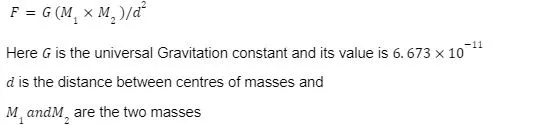
Gravitation formula
According to the gravitational law :The force that a thing exerts on another object is equal to the product of their masses and inversely proportional to the square of their distance.
Work
The resultant force acting in the direction of displacement and the magnitude of the object’s displacement is the work done.co
W=Fcos×s joules
If angle is 0 the
W=F×s
Here F is the force & S is the displacement.
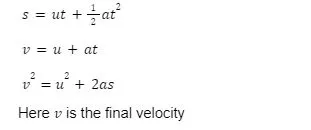
Motion in one dimension formula
The formula for motion in one dimensions are:
And u is the initial velocity.
Momentum
The product of a body’s mass and velocity is its termed as momentum:
P=massm×velocity(v)
Here P the momentum
m is the mass of the body and
v is the velocity of the body
Impulse
An impulse is a large force applied in a brief amount of time. A hammer’s striking is an impulse.
I=m(v-u)
Here I is the impulse
v is the final velocity and
u is the initial velocity
Angular Momentum
When a body is rotating, it has angular momentum, which is similar to linear momentum.
The formula of angular momentum is given as:
L=I × ⍵
Here L is the Angular Momentum
I is the Moment of Inertia
⍵ is the Angular Velocity
Torque
Torque is defined as a force moment. Rotational motion is caused by torque.
The formula of torque is:
τ=r ×F
Here is the torque
r= radius vector and
F = force
Circular Motion
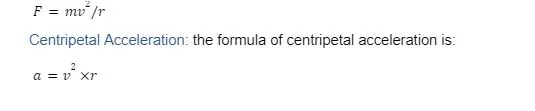
There are two types of circular motion:
Centripetal force: the formula of Centripetal force is:
Conclusion
Physics is all about articulating real-world values rather than memorising them. Many concepts, difficulties, and mathematical formulas may be encountered during applications. Physics is the study of how our universe’s fundamental parts interact.
Average speed formula: It is used to determine a moving body’s average speed(S) for the distance travelled (D) as well as the time period (T).
Formula will be:
S=d/t
Pressure Formula: The amount of force exerted per unit area of the object is known as pressure.



 Profile
 Settings
 Refer your friends
 Sign out