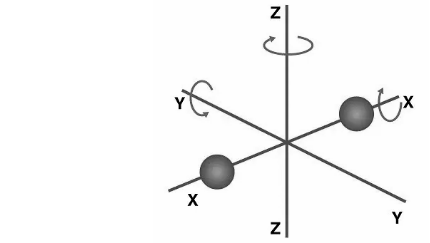
The equipartition theorem connects a system’s temperature to its average energy. The original concept of equipartition was that energy is shared equally across all of its forms in thermal equilibrium; for example, the average kinetic energy per degree of freedom in a molecule’s translational motion should equal that of its rotating motion. A single atom can freely move along the X, Y, and Z axes in space. Each of these actions, however, necessitates the expenditure of energy. This is derived from the atom’s stored energy. The Law of Energy Equipartition determines how much energy is allocated to each atom’s motion (translational, rotational and vibrational).
Types of molecules | N | Degree of freedom | Modes |
monoatomic | 1 | 3 | 3 transitional 0 rotational 0 vibrational |
diatomic | 2 | 6 | 3 transitional 2 rotational 1 vibrational |
Triatomic linear | 3 | 9 | 3 transitional 2 rotational 4 vibrational |
Triatomic non linear | 3 | 9 | 3 transitional 3 rotational 3 vibrational |
For every dynamic system in thermal equilibrium, the law of energy equipartition is defined as the equal distribution of energy among the degrees of freedom.
Let’s look at how kinetic energy is distributed evenly in a single molecule along the x, y, and z axes.
When a gas is at thermal equilibrium, its average kinetic energy is expressed as.
the average kinetic energy is expressed as.
The Boltzmann constant is written as Kb, while vrms is the square root of the molecules’ velocity.The temperature of the gas is denoted by the letter T.
What is equipartition of energy:
The concept behind equipartition is that, under thermal equilibrium, the energy of a system is equally shared among all the forms of energy. This means that the average kinetic energy for each degree of freedom will be equal in both translational motion and rotational motion.
In classical statistical mechanics, the equipartition theorem ties a system’s temperature to its average energy. The equipartition theorem is also known as the law of equipartition, energy equipartition, or simply equipartition. The original concept of equipartition was that in thermal equilibrium, energy is distributed evenly among all of its forms; for example, in translational motion, the average kinetic energy per degree of freedom should be equal to that in rotating motion. The equipartition theorem is used to make quantitative predictions. Similar to the virial theorem, it provides the total average kinetic and potential energies for a system at a given temperature, from which the system’s heat capacity can be derived.



 Profile
 Settings
 Refer your friends
 Sign out