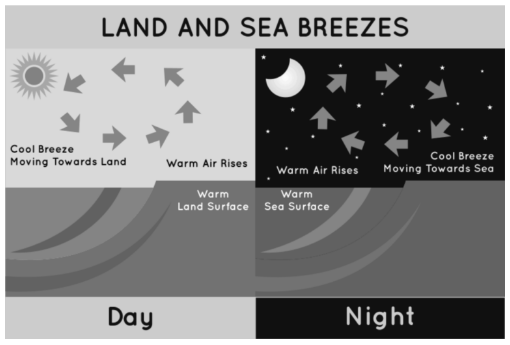
We all feel quite calm when we go near a water body in the evening and enjoy the cool wind blowing near the water body. On the other hand, we feel cooler by putting our feet in the water rather than standing barefoot on the ground if we go near a water body during the day when it is blistering hot. This occurs as a result of the land and sea breezes. Have you ever puzzled why, when the same Sun is heating both the land and the ocean, we perceive such a difference in temperature?
The land heats up more quickly and cools down more slowly. As a result, land or sand cools off before the ocean after sunset. The land air is cooler than the sea air at this time, resulting in a low pressure over the sea. As a result, the air from the land flows towards the sea. Land breeze refers to the breeze or wind blowing from the land to the sea, as the name implies. Offshore breeze is another name for it. When the land air is cooler than the sea air, it usually happens at night or early in the morning.
The land air heats up faster during the day while the sun is shining, whereas the sea air heats up more slowly. As a result, the sea air is cooler and heavier at this time, and it flows towards the land. Sea breeze, as the name implies, is the breeze or wind blowing from the sea towards the land. It is most common during the warmer months. Onshore breeze is another name for it.
Differential heating and cooling of nearby land and water surfaces causes land and sea breezes to form. Land absorbs and emits radiation more efficiently and faster than water because water has a higher heat capacity. The inland-moving sea breeze lowers the temperature while increasing humidity.
Based on various factors they are differentiated as:
Land breezes are created during the night.
During the day, a sea wind forms.
Land breeze comes from the ground, whereas sea breeze comes from the water.
Because the air over land cools in a shallower layer at night, the land breeze is also shallower than the sea breeze.
Because of the substantial temperature differences between land and ocean, sea breezes are more common in the spring and summer. Land breezes, on the other hand, are more common in the fall and winter because of the cooler nights.
Because of the larger temperature variations, sea breezes are generally stronger than land breezes.
Because of the absorbed particles from bodies of water, sea breezes have higher moisture. Land breezes, on the other hand, are frequently dry winds.
Sea breezes, unlike land breezes, are rarely seen during the winter months. Land breezes are predominant in affecting weather during such frigid months, especially when a strong change in wind direction happens at night.
Glider pilots, in particular, use the sea breeze to help them steer at higher altitudes. Sea breezes, unlike land breezes, are strong enough to affect aircraft operations.
Sea breezes are more likely to induce a drop in air temperature, but land breezes do not typically cause temperature changes.
Around large bodies of water, both land and sea breezes exist.
The key reason for the Breeze is that water retains heat for a longer duration. The difference in temperature between land and water causes the density of the air over their respective surfaces to alter. The Breeze is created by the alternating airflow that is induced by the low pressure. Sea breezes are cool during the day and warm at night for those who live near the coast.Temperature, humidity, and precipitation rates are all affected by these
breezes. The diagrams of land wind and sea breeze, as well as an explanation of how they arise, are provided above.



 Profile
 Settings
 Refer your friends
 Sign out