A galvanometer is a sensitive device (or instrument) used to detect and measure the feeble (or weak) electric current passing via an electric circuit.
When an electric current flows through the coil in a constant magnetic field, the pointer of the galvanometer shows deflection. The amount of this deflection is proportional to the amount of current passed.
An ammeter is an electrical device (or instrument) used to measure large amounts of electric current. The ammeter is put in a series connection with the circuit through which the current passing is measured.
A galvanometer needs to be converted into an ammeter to measure large amounts of current. Let us learn about the factors involved in converting a galvanometer into an ammeter and the materials required to convert a galvanometer into an ammeter.
How can a galvanometer be converted into an ammeter?
Here are the factors involved in converting a galvanometer into an ammeter:
A low resistance – known as shunt resistance (S), is connected in parallel to the galvanometer to convert a galvanometer into an ammeter.
The scale of measurement is then calibrated in amperes (A).
The range of the ammeter is dependent on the value of the shunt resistance.
To increase the range of the ammeter, say n times, the value of shunt resistance is:
S = G ⁄ (n-1)
Now that we have an idea about the factors involved in converting a galvanometer to an ammeter let us look at the materials required to convert a galvanometer into an ammeter.
Materials required
A galvanometer
A shunt resistance
A large amount of electric current
A working electric circuit with batteries and connecting wires
Procedure to convert a galvanometer into an ammeter
Consider the following figures
Let ig be the electric current passing via the galvanometer G, whose resistance is rg via the path AGB.
Then the remaining current is (i – ig), which passes along the path ACDB via the shunt resistance S.
The value of shunt resistance is adjusted accordingly to ig to produce a full-scale deflection.
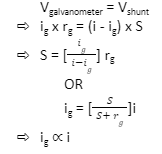
The potential difference across the galvanometer is equal to the potential difference across the shunt resistance.
Since we know that the range (or amount) of deflection in the galvanometer (say, θ) is proportional to the amount of current passing through it, we have:
Hence, the deflection of the galvanometer is a measurement of the current i passing via the circuit.
We already know that the shunt resistance is connected in parallel with the galvanometer. Hence, the resistance of the formed ammeter (say, ra) can be found by calculating the effective resistance (say, reff). That is:
Important points to be noted while converting a galvanometer into an ammeter
Since the value of one of the major factors involved in converting a galvanometer to an ammeter, the shunt resistance S, is small, the ratio of (S / rg) is also small. This consequently means that the value of rg, which is the resistance offered by the formed ammeter, is also small.
Hence, when the formed ammeter is connected with the electric circuit, it offers negligible resistance and does not change or affect the current passing via the circuit.
For an ideal ammeter, the resistance produced or offered should be equal to zero. Since it is not so for an actual ammeter, the reading shown by an ammeter is always lesser than the actual electric current passing via the circuit.
Considering Iideal as the current measured by an ideal ammeter and Ireal as the current measured by a real ammeter, the percentage of error in the measurement of current by an ammeter is given by:
Conclusion
A low resistance – known as shunt resistance S – is connected in parallel to the galvanometer to convert a galvanometer into an ammeter. The scale of measurement is then calibrated in amperes (A). The range of the ammeter is dependent on the value of the shunt resistance.
Since the value of one of the major factors involved in converting a galvanometer to an ammeter, the shunt resistance S, is small, consequently, the value of rg, which is the resistance offered by the formed ammeter, is also small. Hence, the ammeter offers negligible resistance and does not change or affect the current passing via the circuit.



 Profile
 Settings
 Refer your friends
 Sign out