Gamma rays were first observed during radioactive decay. In 1899, Rutherford first differentiated between this ray and the other two types. Initially, he considered these rays as fast beta particles. But with the help of a magnetic field test, when it was established that they have no charged particles, then that old idea was rejected. In 1914 with the help of a reflection test on the crystal surface, it was proved that these rays are nothing but EM waves.
These rays are produced in different reactions, but we shall focus only on radioactive decay reactions.
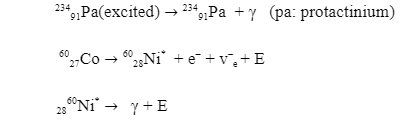
During a radioactive decay reaction, alpha or beta or both in a nucleus of an atom gets excited. Just like an electron returns to its lower energy state by emitting photons (not a gamma-ray photon), in the same way, an excited “daughter” nucleus also emits photons of the lowest wavelengths to gain stability. Such reactions are one of the important sources of gamma rays. Examples of such reactions are-
There is another type of reaction where gamma rays are produced, and that is called electron capture. This is the opposite process of beta production. An example of one such reaction is:
Following are the properties of gamma rays:
Ionising power of radiation is its capacity to ionise other molecules when it passes through those molecules. When the radiation passes through a medium, the atoms of that medium lose electrons and get ionised. Gamma rays have very low ionising power.
The ability of radiation to pass through matter, such as the human body, walls, etc., is known as the penetration effect. Gamma rays have a high penetrating power.
In general, the greater the mass present, the greater the ionising power and the lower the penetration power.
Property | Alpha | Beta | Gamma |
Nature | Positively charged helium particle | Negatively charged particle | EM waves |
Charge | Positively charged (2 units) | Negatively charged (1 unit) | No charge |
Mass | Mass of a helium atom | Mass of an electron | Massless |
Ionisation potential | Highest | Moderate | Lowest |
Penetration power | Lowest | Moderate | Highest |
Range(approx) | 10 cm in air | Few metres | Several metres |
From the above discussion, it is quite clear how gamma rays originated, and how it is different from other radioactive rays.
Gamma rays are one of the most important types of EM waves. Due to its very high value of penetration power, an object that radiates these rays is conserved in lead-coated boxes. In physics and astronomy, these rays have immense uses. For example, with the help of gamma-ray wave spectroscopy, scientists measure the amount of gamma-ray radiated from a sample and by measuring this amount, different elements can be identified. This concept is applied by researchers to know the geochemistry and composition of other planets.



 Profile
 Settings
 Refer your friends
 Sign out