During simple harmonic motion, energy is constantly exchanged between two forms: kinetic and potential.
The potential energy could be in the form of:
Speed v is at a maximum when displacement x = 0, so:
The kinetic energy is at a maximum when the displacement x = 0 (equilibrium position).
Therefore, the kinetic energy is 0 at maximum displacement x = x0, so:
The potential energy is at a maximum when the displacement (both positive and negative) is at a maximum x = x0 (amplitude).
A simple harmonic system is therefore constantly converting between kinetic and potential energy.
When one increases, the other decreases and vice versa, therefore:
The total energy of a simple harmonic system always remains constant and is equal to the sum of the kinetic and potential energies
The kinetic and potential energy of an oscillator in SHM vary periodically
Note: kinetic and potential energy go through two complete cycles during one period of oscillation
This is because one complete oscillation reaches the maximum displacement twice (positive and negative)
The kinetic energy is the opposite: it is 0 at the amplitude positions x0 and maximum at the equilibrium position x = 0
The total energy in SHM is given by,
E=12mω2A2
where A is the amplitude and remains conserved.
E=K + U
Kavg=Uavg=E2=14mω2A2
Note:
Average kinetic energy can also be found using
Kavg=1T0TKdt
Average potential energy can also be found using
Uavg=1T0TUdt
Use the relation between restoring force and potential energy
Restoring force is given by:
F=- d Ud X
It is often useful to find the equation of SHM.
Example:
A particle of mass 10 gm is placed in a potential field given by V=(50x2+100)J/kg. Find the frequency of oscillation in cycle/sec.
Solution:
Potential Energy U=mV
U=10-250x2+100
F=- d Ud X=-(100x)10-2
m2x=-(10010-2) x
1010-32x=-10010-2x
2=100, =10
f= 2=102=5
Restoring torque of an SHM can be found by:
=-dUd
It is often useful in finding the equations of SHM and helps in solving problems.
Potential energy per unit length (w) at a point is defined as:
w=pvc
p is the sound pressure.
v is the particle velocity in the direction of propagation.
c is the speed of sound.
EXAMPLE
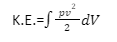
Kinetic energy per unit length at a given point in a travelling sound wave
The Kinetic Energy of a travelling sound wave is defined as:
The key ingredient in performing work is energy, which is a quantitative feature of matter. The ability to work is defined as energy. For many sorts of motions, energy is the fundamental unit. Deformations can also be caused by energy, depending on its intensity. “Energy cannot be generated or destroyed, but it can be converted from one form to another,” according to the laws of conservation of energy. The Joule is the international system of energy measuring units.
SHM stands for Simple Harmonic Motion, which is described as a motion in which the restoring force is proportional to the body’s displacement from its mean position. SHM is a type of oscillation in which motion is carried out in a straight line between two extreme points. In SHM, a restoring force is shown pointing toward the mean position or the equilibrium position. In simple harmonic motion, the mean position is a stable equilibrium.



 Profile
 Settings
 Refer your friends
 Sign out