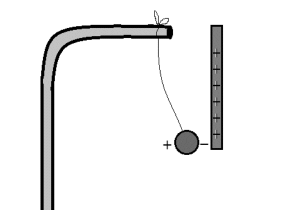
Around 600 BC, Thales of Miletus in Greece is credited with discovering that amber rubbed with wool or silk cloth attracts light things. Electricity is derived from the Greek term Electron, which signifies amber. When light items like straw, pith balls, and shreds of paper are brushed together, they create an attractive force between them. Humans can achieve a similar effect at home by engaging in the activities listed below. Cut out long, thin strips of white paper and softly iron them. Bring them up near a TV or computer screen. It’s been noticed that the strips are drawn to the screen. In fact, it remains riveted to the television for an extended period of time.
Induction charging is a means of charging a thing without it actually touching another charged object. During the charging by induction technique, the charged particle is held near an uncharged conductive substance that is grounded on a neutrally charged material. When a charge flows between two objects, the uncharged conductive substance develops a charge opposite the charged object’s polarity.
The Coulomb electrostatic force, which is measured with an electroscope, causes the test charge to move. Because the electrostatic charge of an object is proportional to its capacitance, electroscopes are widely employed as basic voltmeters. An electroscope requires a significant number of volts to detect a large enough concentration of charge.
Electroscopes are widely employed with high-voltage sources such as static electricity and electrostatic devices as a result of this. An electrometer is a device that measures electrostatic charge quantitatively.
The electroscope can be used for a variety of things:
The two most popular types of electroscopes are as follows:
Around 600 BC, Thales of Miletus in Greece is credited with discovering that amber rubbed with wool or silk cloth attracts light things. Electricity is derived from the Greek term Electron, which signifies amber. When light items like straw, pith balls, and shreds of paper are brushed together, they create an attractive force between them. Humans can achieve a similar effect at home by engaging in the activities listed below. Cut out long, thin strips of white paper and softly iron them. Bring them up near a TV or computer screen. It’s been noticed that the strips are drawn to the screen. In fact, it remains riveted to the television for an extended period of time.
Induction charging is a means of charging a thing without it actually touching another charged object. During the charging by induction technique, the charged particle is held near an uncharged conductive substance that is grounded on a neutrally charged material. When a charge flows between two objects, the uncharged conductive substance develops a charge opposite the charged object’s polarity.
The Coulomb electrostatic force, which is measured with an electroscope, causes the test charge to move. Because the electrostatic charge of an object is proportional to its capacitance, electroscopes are widely employed as basic voltmeters. An electroscope requires a significant number of volts to detect a large enough concentration of charge.
Electroscopes are widely employed with high-voltage sources such as static electricity and electrostatic devices as a result of this. An electrometer is a device that measures electrostatic charge quantitatively.
The electroscope can be used for a variety of things:
The two most popular types of electroscopes are as follows:
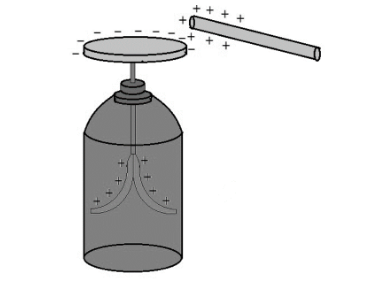
Two thin gold leaves are attached to the bottom end of a vertical metal rod encased in a box to make an electroscope. The charge is transferred to the leaves when a charged gadget comes into contact with the metal knob at the top of the rod, causing them to diverge. The degree of divergence indicates the amount of charge.
because like charges repel each other, the leaves split once more. When the charge is removed, the electrons return to their original place, and the leaves relax.
In both cases, the electrons return to their natural state as soon as the charged body is removed. In addition, the electroscope cannot tell whether a charge is positive or negative; it can only detect its presence in a body.
The Coulomb electrostatic force, which causes the motion of the test charge, is used by the electroscope to detect the charge. Because the electric charge of an object is equal to its capacitance, an electroscope can be used as a primitive voltmeter. The term “electrometer” refers to a device that measures charge quantitatively.



 Profile
 Settings
 Refer your friends
 Sign out