Electromagnetic induction, which is sometimes also called magnetic induction, is related to emf or electromotive force across an electric conductor. At the same time, there is a change occurring in the magnetic field.
Michael Faraday is the one who discovered induction for the first time in 1831 when James Clerk, who was a Scottish mathematician, described Faraday’s law of induction mathematically.
Faraday’s laws of electromagnetic induction are the basis of electromagnetism. It predicts how a magnetic field will interact with an electric circuit for the production of electromotive force (emf). The whole thing combined is called electromagnetic induction.
It is the phenomenon of the production of induced current in a coil placed in a region where the magnetic field changes with time.
To derive the laws of electromagnetic induction, Michael Faraday performed many experiments. His three experiments amongst all are the most important ones in discovering electromagnetic induction.
Michael Faraday has given two laws of electromagnetic induction.
In his first law of electromagnetic induction, Faraday and Henry worked together. It is the first conclusion made by Faraday after his many experiments. Thus, we can estate the first law of Faraday regarding electromagnetic induction as follows:
An electromotive force (emf ) is generated when a current is induced in a conductor circuit, creating a magnetic field variation.
The current induced in a circuit is termed as induced current when the conductor circuit is closed.
We can change the magnetic field intensity in a closed-loop in different ways. Let us discuss some of them below :
According to Faraday’s second law of electromagnetic induction, the emf or electromotive force generated by the change in the magnetic field in the coil is equal to the rate of the change of the flux leakage.
Methods to increase the induced electromotive force in a coil:
Michael Faraday was an English scientist of the 19th century. He is credited with many great discoveries in physics and chemistry. However, he is popularly known for his discovery in the field of electromagnetism. Where he experimented with a coil and a magnet. Faraday performed several experiments to give the law on electromagnetic induction. The term induction means to generate or induce something. He has passed two electromagnetic laws of induction. He was the first who introduced electromagnetic induction to us. The term electromagnetic induction refers to the production of electric currents caused by the magnetic field. A magnetic field produces a current in a conductor. His law is related to the show of electromotive force. An electromotive force may be an electrical action made by a non-electrical source. It is abbreviated as emf. The transducers provide electromotive force by converting a form of energy to another form of energy, such as a transducer battery, which converts chemical energy to electrical energy.
Faraday’s law of induction is the basic operating principle of inductions, electric generators, electric motors, power transformers, musical instruments such as electric guitar, electric violins etc. Thus, we can say that the law of induction given by Faraday is beneficial in our daily life as we deal with so many electric types of equipment of our everyday use, which are working in Faraday’s laws of electromagnetic induction.
The factors on which the mean free path depends are:-
The mean free path that is independent of density is called a specific mean free path. This doesn’t change with the change of density with respect to time.
The unit of specific mean free path is g/cm²
To obtain the actual mean free path, the specific mean free path can be divided by the density.
In gamma-radiography, the mean free path of a pencil beam of mono-energetic photons is the average distance a photon travels between collisions with the atoms of the target material.
In X-ray radiography, the photons are not mono-energetic, and hence, the calculation of the mean free path becomes very complex. However, the photons follow a spectrum of distribution of energies and hence, when they move through the target material, they are attenuated with probabilities with respect to their energies. This results in the hardening of the spectrum because of which the mean free path of the spectrum changes with distance.
The mean free path of a charge carrier in a metal L is proportional to the electric mobility. The thickness of a thin film can be lesser than the mean free path, making surface scattering much more noticeable and increasing resistivity.
The relation for the mean free path of a single particle that bounces off the walls helps in the derivation of the Sabine equation in acoustics. The derivation uses the geometrical approximation of sound propagation.
In nuclear and particle physics, the concept of mean free path is replaced by the concept of attenuation length. For high-energy photons interacting by electron-positron pair production, the concept of radiation length is used in place of the concept of mean free path.
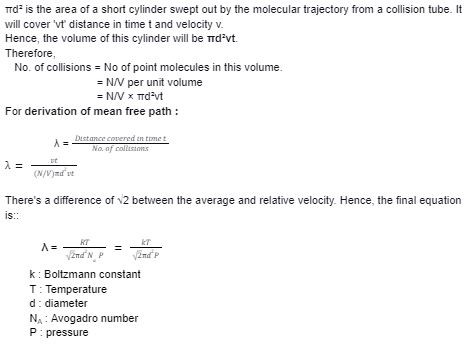
When the particles pass through any material, they may start moving in different directions due to the collisions that take place in between them. The average distance between the particles after collision is known as the mean free path, which depends on factors like pressure, volume, temperature, density, etc. It also depends on the type of cross-section used in the calculations, i.e. scattering cross-sections or total cross-sections. It also depends upon the energy distribution of the particles with respect to the medium.



 Profile
 Settings
 Refer your friends
 Sign out