One of humanity’s greatest inventions is the electric motor. We would have been nothing more than shining bulbs with energy if it hadn’t been for the invention of the motor. Electrical energy is converted into mechanical energy by the electric motor.
Electric motors are typically designed to rotate continuously. The electric motor, to be precise, is utilised to generate rotational energy. Electric motors are a gadget that we all employ in our daily lives.
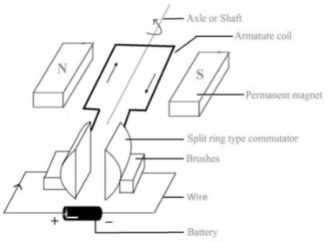
A machine that converts electrical energy into mechanical energy is known as an electric motor. When a current-carrying conductor is put in a magnetic field, it is subjected to forces that aid in shaft or axil rotation.
A motor is a mechanical device that converts electrical energy into mechanical energy. Spinning blades in a mixer, for example, mash and incorporate contents. The mixer’s electric energy is turned into mechanical energy when the blade rotates, producing the desired action.
The following are the components of a basic motor:
Motors are classified according to their power source:
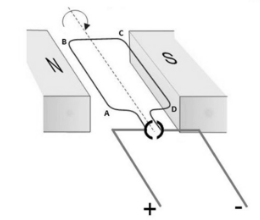
Towards the north pole, current flows from A to B, and near the south pole, current flows from C to D. As a result, the field lines and the current direction are perpendicular to each other. As a result, the sides AB and CD are subjected to a force whose direction is determined by Fleming’s left-hand rule.
Side AB is subjected to an upward force, whereas side CD is subjected to a downward force. As a result, the rectangular coil ABCD moves in a circular motion. Due to the split ring, current flows in the directions D to C near the north pole and B to A near the south pole after the half rotation. As a result, the force on both sides does not change direction, and the coil rotates constantly.
DC motors are classified as follows based on how the electromagnet poles and armature windings are connected:
There are two types of self-excited motor:
Alternating current (AC) is used to power AC motors. The magnetic field can be rotated by utilising alternating current. Synchronous speed refers to the rotational speed of the field. The equation can be used to compute the synchronous speed:
Here, Ns is the synchronous speed, f is the frequency of the AC supply and P is the number of Poles in the motor.
Synchronous motors are classified as single-phase or three-phase synchronous motors, depending on the phase of the AC supply.
Types of Induction motor based on the AC supply
We’ve seen how the interaction between electricity and the magnetic field is used to create a moving force in this article. Motors are separated into two types based on the source of electricity: DC and AC motors. Depending on the source of electricity, the sorts of electricity, and the nature of the task to be done, we employ several types of motors.



 Profile
 Settings
 Refer your friends
 Sign out