The electrostatic force exists between two charged particles and acts as an attraction or repulsion force. Coulomb’s interaction, or Coulomb’s force, is another name for it. The electrostatic force between protons and electrons in an atom, for example, is what keeps the atom stable. Because it links an ionic molecule, the electrostatic bonding force is important in chemistry.
“Electricity” is derived from the Greek word “Elektron,” which means “amber.” Materials, atoms, and molecules have magnetic and electric forces that influence their properties. There are only two types of entities that are referred to as “electric charge.” An experiment revealed two types of electrification: the first involves like charges repelling each other, and the second involves unlike charges attracting each other. The polarity of charge is the defining characteristic of these two types of charges.
The transport of electric charge is aided by conductors, but not by insulators, according to an experiment on electric charges generated by frictional electricity. Metals, the Earth, and human bodies are all conductors, but porcelain, nylon, and wood are all insulators, preventing electricity from flowing through them.
An electric field is a region of space around an electrically charged particle or object where the charge feels forced. The electric field may be examined by putting another charge into it, which exists everywhere in space.
For practical purposes, the electric field can be approximated as 0 if the charges are far enough away. Electric fields are represented by arrows pointing toward or away from charges as a vector quantity. The lines must either point radially outward, away from a positive charge, or inside, toward a negative charge.
The magnitude of the electric field is computed using the formula:
E=F/q
where E denotes the strength of the electric field, F denotes the electric force, and q denotes the test charge.
An electric force is the interaction of two charged objects that is either repulsive or attractive. Newton’s equations of motion, like any other force, define the impact and effects of any force on a specific body. The electric force is just one of the many forces that act on objects.
Newton’s laws can be used to investigate motion caused by a specific force or group of forces. The analysis begins with the production of a free body diagram in which the vector indicates the direction and type of individual forces such that the resultant sum, known as the net force, may be used to compute the body’s acceleration. An electric force is the interaction of two charged objects that is either repulsive or attractive. Newton’s equations of motion, like any other force, define the impact and effects of any force on a specific body. The electric force is just one of the many forces that act on objects.
Newton’s laws can be used to investigate motion caused by a specific force or group of forces. The analysis begins with the production of a free body diagram in which the vector indicates the direction and type of individual forces such that the resultant sum, known as the net force, may be used to compute the body’s acceleration.
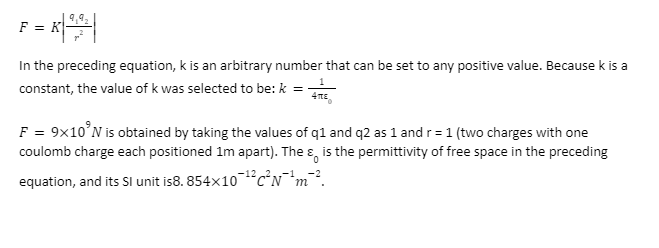
Coulomb’s law is an analytical law that determines the amount of force that exists between two stationary electrically charged particles. The electrostatic force, commonly known as Coulomb’s force, is an electric force that exists between two charged bodies that are stationary. Coulomb’s law describes the amount of electrostatic force between stationary charges. The force acting along a line connecting two-point charges is proportional to their product and divided by the square of the space between them.
Some instances of these forces are as follows:
Current electricity, such as copper wiring that transports power throughout the building, can also be used to observe the electric force. Static charges, such as cathode-ray tubes in televisions and electrostatic spray painting, are examples of the electrostatic force.
The following are some examples of how Coulomb’s Force is used:
The electrostatic force between two charged particles can be calculated using Coulomb’s law. It connects the electrostatic force, charge magnitude, and separation distance, and is most typically employed with point charges. According to this rule, the force between the two particles is,



 Profile
 Settings
 Refer your friends
 Sign out