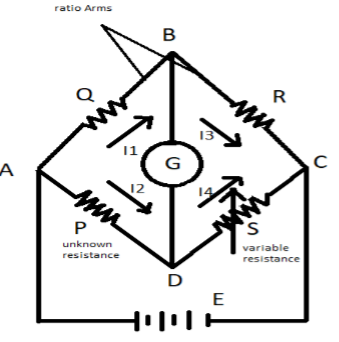
The Wheatstone bridge is a very useful device. It is used to measure resistances that are not known. It uses a principle that lets it measure the unknown resistance with the help of known resistance. Therefore, a Wheatstone bridge can be defined as a device used to calculate medium or minimum resistance by comparing it with known resistance. The measurement of the Wheatstone bridge is accurate and reliable. The Work of Wheatstone bridge is very similar to that of the potentiometer. Wheatstone bridge can only measure low and medium resistance. An ammeter is used to measure high resistances. An ammeter beats the Wheatstone bridge in the category of sensitivity. Let’s learn more about the Wheatstone bridge working principle.
The Wheatstone bridge working principle is null deflection. The condition of null deflection is the ratio of the known resistances should be equal and that no current should flow through it, i.e., no deflection in the galvanometer. Before working on it, we have to prepare the Wheatstone bridge. In normal conditions, it remains in an unbalanced form. This means current flows through the galvanometer. Only after adjusting the known resistance and the variable resistance can we say that no current flows through the galvanometer. This is called a balanced form.
The above diagram is the representation of a Wheatstone bridge. This is the main circuit of the Wheatstone bridge.
A potential difference is applied across AC when the Wheatstone bridge is unbalanced and current flows through the galvanometer. The resistance Q, R and S must be varied to achieve a balanced state. The potential difference across AB should equal the potential difference across AD. Then no current will pass, and the galvanometer will show zero deflection. The flow of current is marked in the diagram. Let us find the unknown current P.
Underbalanced conditions, the potential difference across AB is equal to that of AD.
[ as V=IR] Let’s take this as equation (i).
Now when the Wheatstone bridge is balanced, we can also write:
I1 = I3 = E/Q+R and,
I2 = I4 = E/P+S
Now, equating the value of I1 and I2 in equation (i).
E/(Q+R)x Q = E/(P+S) x P
Or, Q/Q+R = 1/(P+S/P)
Or, S/P = (Q+R-Q)/Q
Or, S/P = R/Q
Or, P = QS/R
Here,
Any movement of a small current can show deflection in the galvanometer. Therefore, the deflection of the galvanometer depends on the sensitivity of the Wheatstone bridge. The formula of sensitivity S is given by:
S= Θ/Ig
This formula is used when we measure current.
S=Θ/Vg
This formula is used when we measure the voltage of the galvanometer.
Here,
The sensitivity can also be measured as the ratio of the deflection of the galvanometer to the unit unknown resistance.
S= Θ / (△R/R)
Kirchoff’s law can also demonstrate the Wheatstone bridge. There are many uses of the Wheatstone bridge. Let us summarise the main points. The diagram of the Wheatstone bridge is very important. One should practice the labels and mark the direction of the arrows. One wrong direction of an arrow can dismiss the whole diagram. The Wheatstone bridge working principle is important. Sums should come from the formula of the unknown resistance and the sensitivity of the Wheatstone bridge. We should also study the limitations of the Wheatstone bridge. One should also go through Kirchoff’s law to better understand the topic.



 Profile
 Settings
 Refer your friends
 Sign out