The Van de Graaf generator can effectively make a very high voltage. Robert Jemison Van de Graaff designed it in 1929 A.D. it can generate a voltage in millions. It works by aggregating charge on an empty metal construction with a moving belt. This construction is designed in the shape of a globe and sits atop an insulating column. Thus, it creates an exceptionally high electric capability of two or three million volts. This produces a massive electric field. To speed up charged particles, we utilise an electric field. Using this generator has several benefits: the generated output is ripple-free, flexible, and precise in voltage control.
The generator is housed in a metallic cylindrical cylinder that is earthed. A high-pressure oil vacuum powers it. A belt is constructed of an insulating material such as silk or rubber. The gatherer snack is associated with the high voltage anode. The lower snack gets an excitation voltage utilising a hand-driven pulley or another instrument. The belt conveys the positive charge. The positive charge moves to the authority snack when the belt is raised. It gathers a positive charge and transports it by belt. The gained output is ripple-free.
Van de Graaff Generators are electrostatic “constant current” devices that operate primarily on two principles:
V = Q / C gives the potential of a high voltage electrode above the ground at any given time.
Q is a charge store that is powered by a belt.
The capacitance of the high voltage electrode to the earth is denoted by C.
Beneath referenced focuses are the benefits and inconveniences of the Van De Graaff generator.
A generator’s primary function is to transform mechanical energy into electrical energy. However, we may readily generate electrical power and very high voltage by employing the Van De Graaff generator.
The other advantages of the Van de Graaff generator are:
Van de Graaff generators are two types: those that use a high-voltage power supply for charging and those that use belts and rollers. When we ground the resulting terminal (round) with a grounded object on the Van de Graaff generator, the voltage drops; however, the ongoing stay is very similar.
Static charges are framed by grinding between two protecting bodies scouring against one another because they can’t continue all alone (very still). It is a valuable generator as very high voltage can be easily created. Also, the generated output is ripple-free, and the generator’s constructor is that type that produces a charge accumulated in the hollow part of the metal ball.
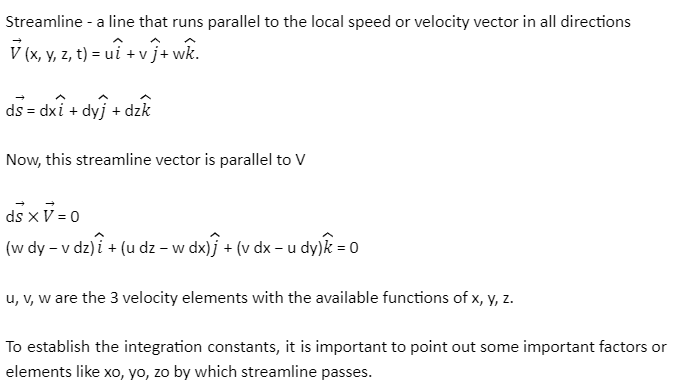
For 2D, we get some values like dz = 0 & w = 0.
k is non-trivial, now the derived equation for streamlines are written as follows:
dy/dx = v/u
This is called the Ordinary Differential Equation (ODE) for streamlining the flow of any fluid. This equation is based on the trajectory drawn in the diagram.
Fluid movements at slow speed or velocities are recognised as streamlining flow. it will depend on the tap opening. If you slightly open the tap, then the water flows slowly and smoothly and it shows its smooth texture. This is called streamlined flow. So the water flows in the pipes. Taps are the famous examples of streamlined flow .
The movement of spermatozoa and the movement of blood in veins are also some unique examples of streamlined flow.
A good example of a streamlined flow is the motion of water droplets in a river. Streamline flow is often used to describe the motion of fluids because it is easy to understand and is a good way to visualise the movement of fluids.
The first example of streamlining flow is the motion of hot gas through a nozzle. The second example is the movement of water through a pipe. The third example is the flow of air over an aeroplane wing.
Conclusion
A streamline is an important concept in fluid mechanics. It can be used to show the flow of a fluid, as well as to determine the velocity and direction of flow. In fluid mechanics, streamlining is the base concept for various other concepts like turbulent flow and many others. Streamlines definition, equations, and examples are completely explained in the above sections. By reading those concepts, you can easily unravel the concept behind the streamline.



 Profile
 Settings
 Refer your friends
 Sign out