An AC generator, also known as a generator, is a device that converts mechanical energy to electrical energy. Technically, the term generator is inaccurate as generators do not generate electricity; it converts mechanical energy to electrical energy.
An AC generator is a device in which a current reverses its direction after a regular interval of time, converting mechanical energy to the alternating form of electrical energy. Nikola Tesla, the famous Yugoslavian scientist, is credited with the modern form of the AC Generator. He built this AC generator in the year 1888.
An AC generator works on the principle of electromagnetic induction. When a closed coil is rotated in a magnetic field that is uniform, with the axis of the coil perpendicular to the magnetic field, the magnetic flux related to the coil changes, and an emf is induced, producing current.
An AC generator consists of the following parts:
The armature coil rotates, and the magnetic flux varies; therefore, an induced current flows through it.
Let us consider a coil PQRS, which is in a vertical position initially and is rotated clockwise. The PQ side moves downwards, and the SR side moves upwards. Applying Fleming’s right-hand rule, we can say that the flow of current is from Q to P and S to R. This is the first half of the rotation, and the flow of current is in the direction SRQP with the brush B1 acting as the positive terminal and brush B2 as the negative terminal. During the second half of the cycle, vice versa happens, and B1 becomes the negative terminal, and B2 becomes the positive one. Therefore, an alternating current is produced by the AC generator.
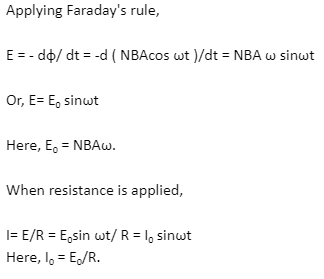
Expression of Induced Emf
Let us consider,
N = Count of turns present in the coil
A = Total turn area
B = Quantity or value of magnetic field
Θ = Quantity of angle, which is normal to the coil and also contains field B at any instantaneous point of time
Therefore, the flux will be
ф= NBAcosΘ = NBAcos ωt
Some of the advantages are listed below:
AC generators are used for the production of hydroelectricity. The water from dams falls from a height and onto giant water wheels or turbines. The kinetic energy of falling water gets converted to energy of rotation of the turbine and then gets converted to electrical energy by the generators.
AC generators do not generate electricity; rather, it is responsible for converting mechanical energy into alternating electrical energy. The structure of an AC generator includes a field magnet, armature, slip rings, brushes and a source of energy. The basic working of an AC generator can be studied using the concept of electromagnetic induction. It was designed in 1888 by Nikola Tesla and has been in use ever since in many ways, such as the production of hydroelectricity.



 Profile
 Settings
 Refer your friends
 Sign out