One of the most prevalent chemical molecules we encounter in our daily lives is hydrogen peroxide. It can be found in hair bleaching products as well as medical products. In this session, we will dive deeper into the topic of hydrogen peroxide, covering its structure, properties, and more.
Hydrogen peroxide is a chemical compound composed of hydrogen and water molecules. H2O2 is the chemical formula for it. When hydrogen peroxide is pure, it appears as a clear liquid with a faint pale blue coloration. It is more viscous than water. It is, however, a thermodynamically unstable liquid that decomposes when exposed to light. This chemical can be present in the human body as well.
Peroxide is a chemical compound that contains the peroxide ion (O2²–). The peroxide ion is made up of a single bond between two oxygen atoms and is denoted by the symbol (O–O)²–. It is an extremely potent oxidant.
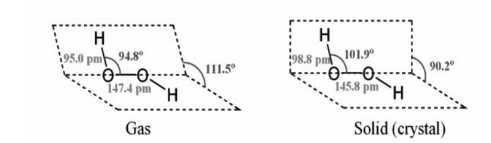
The peroxide link connects two oxygen atoms in a non-planar molecule called hydrogen peroxide.
It’s written in a book-like format. A single connection connects each oxygen atom to each hydrogen atom. The two bonds do not lie in the same plane because lone pairs of electrons repel each other across oxygen atoms. The dihedral (interplanar) angle between the two planes of hydrogen peroxide is 111.5° while it is gaseous, but 90.2° when it is crystalline. This is caused by intramolecular hydrogen bonding.
The valence bond theory can also be used to describe the structure of H2O2, as both oxygen atoms are sp-hybridized. Lone pairs of electrons occupy two of these hybrid orbitals on each oxygen. The third hybrid orbital makes an O-H sigma bond with the s-orbital of a hydrogen atom, while the fourth forms a sigma bond with the second oxygen atom’s half-filled hybrid orbital.
In both the gaseous and crystalline phases, the hydrogen bond parameters are:
From sodium peroxide (Merck’s Process): In this technique, sodium peroxide is added in minute amounts to a weak sulphuric acid (20%) solution covered by ice and regularly stirred. Crystals of Na2SO4. 10H2O occurs as the solution is cooled further, and they can be filtered out. A 30 percent hydrogen peroxide aqueous solution is used.
From barium peroxide: A 20 percent ice-cold sulphuric acid solution is used to treat a hydrated barium peroxide (BaO2.8H2O) paste prepared in ice-cold water. The BaSO4 precipitate, which is white in appearance, is removed using filtration. Only around 5% of the H2O2 is left in the solution.
Because barium sulphate forms a protective coating around H2O2 that prevents it from continuing the chemical reaction, this approach is ineffective. Hydrogen peroxide is progressively decomposed by the Ba2+ ions in the solution. As a result, the solution is not suitable for long-term storage. Instead of sulphuric acid, phosphoric acid is used to test this. In the absence of Ba2+ ions, the barium phosphate that develops is completely precipitated, and there is no risk of hydrogen peroxide breakdown.
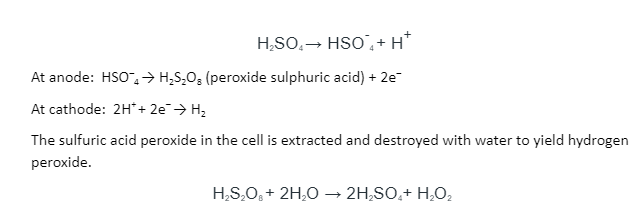
A sulfuric acid solution is electrolyzed to produce: A 50 percent sulphuric acid solution is electrolyzed in a cell. The anode produces peroxodisulfuric acid, which causes hydrogen to be released at the cathode.
Although hydrogen peroxide distils, sulphuric acid with a high boiling point does not. The production of hydrogen peroxide can be boosted by electrolyzing a mixture of ammonium sulphate and sulphuric acid in equal amounts.
The ammonium peroxide sulphate produced at the anode is distilled with water to form hydrogen peroxide.
OxiClean and Tide laundry detergent. When dissolved in water, it produces hydrogen peroxide and sodium carbonate.
H2O2, a colourless liquid often generated as aqueous solutions of varying strengths, is primarily used for bleaching cotton and other textiles and wood pulp, in the synthesis of other chemicals, as a rocket propellant, and for cosmetic and therapeutic applications. Solutions containing more than 8% hydrogen peroxide are corrosive to the skin.
Hydrogen peroxide, which was discovered as a chemical compound in 1818, is the most basic member of the peroxide class. The primary manufacturing procedures include interactions of oxygen from the air with certain chemical molecules, particularly anthraquinone or isopropyl alcohol.



 Profile
 Settings
 Refer your friends
 Sign out