When an element occurs in more than one crystalline form, such forms are referred to as allotropes; diamond and graphite are the two most prevalent allotropes of carbon. A Diamond’s crystal structure is an endless three-dimensional array of carbon atoms, each of which creates a structure with equal angles between its bonds. When the ends of the bonds are joined, the structure resembles that of a tetrahedron, a four-faced three-sided pyramid (including the base). Each carbon atom is covalently connected to four other carbon atoms at the tetrahedron’s four corners. The length of the link between two carbon atoms is 1.54 108 cm, which is referred to as the single-bond length.
Carbon is one of the few elements with a large variety of allotropic forms due to its propensity to have varying oxidation states or coordination numbers. Another issue is carbon’s capacity to catenate. As a result, distinct allotropes of carbon are formed.
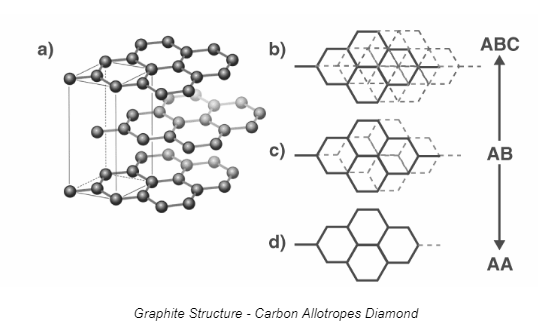
It is a pure form of carbon. This carbon allotrope is formed of hexagonally organised flat two-dimensional layers of carbon atoms. It is supple, dark, and slick solid. Graphite retains this feature due to its ease of cleavage between the layers.
Each C atom in each layer is covalently bonded to three other C atoms through a C-C covalent connection. Each carbon atom in this structure is sp2 hybridised. As the fourth bond, a pi bond is formed. Due to the delocalization of the electrons, they are mobile and capable of conducting electricity.
Graphite is available in two forms: α and ß.
The layers in α form are placed in the order ABAB, with the third layer directly above the first.
The layers are ordered as ABCABC in the ß form.
Graphite has an unusual honeycomb-layered structure. Each layer is composed of carbon atoms arranged in planar hexagonal rings with a carbon-carbon bond length of 141.5 picometers.
Three carbon atoms create sigma bonds, whereas the fourth carbon atom produces a pi-bond. Vander Waal forces hold the graphite layers together.
It is the finest form of carbon in its crystalline state. It has a number of carbon atoms that are tetrahedrally connected. Each tetrahedral unit is composed of carbon bound to four carbon atoms that are itself connected to other carbons. This results in the formation of a carbon allotrope with a three-dimensional arrangement of C-atoms.
Each carbon atom is sp3 hybridised and makes covalent connections with four other carbon atoms at the tetrahedral structure’s four corners.
It is difficult because shattering a diamond crystal necessitates the rupture of several strong covalent connections. It is not easy to break covalent connections. As a result of this feature, this carbon allotrope is the hardest element on the planet.
Buckminsterfullerene (C-60) is also a kind of carbon allotrope. Due to the cage-like structure of fullerene, it resembles a football.
They are spheroidal molecules with the formula C2n, where n equals 30. These carbon allotropes can be synthesised by laser evaporating graphite.
Fullerenes are more soluble in organic solvents than diamonds, which is in contrast to diamonds. C60 fullerene is referred to as ‘BuckminsterFullerene’. sp2 hybridization occurs between the carbon atoms.
Silicates are formed when alkali oxides are fused with SiO2. They are composed of distinct tetrahedral components. Silicon has undergone sp3 hybridization. Carbon allotropes are classed according to their structures.
Carbon’s valence allows for the formation of several allotropes (structurally distinct forms of the same element). Diamond and graphite are two well-known forms of carbon. Numerous further allotropes have been found and studied in recent decades, including ball forms like buckminsterfullerene and sheets like graphene. Carbon nanotubes, nanobuds, and nanoribbons are examples of larger-scale structures. At extremely high temperatures or pressures, other strange forms of carbon occur. According to the Samara Carbon Allotrope Database, around 500 potential three-period allotropes of carbon are known at the moment (SACADA).



 Profile
 Settings
 Refer your friends
 Sign out