All alkanes have names that end in -ane. Whether the carbons are linked end-to-end in a ring (referred to as cyclic alkanes or cycloalkanes) or contain side chains and branches, the name of any carbon-hydrogen chain that does not have any double bonds or functional groups would then end with the suffix –ane The total number of carbons in an unbranched carbon chain is used to name alkanes.
A single chemical compound can have multiple acceptable systematic names, and the systematic approach to naming organic chemical compounds is known as IUPAC Nomenclature; however, no two compounds can have the same name.
For the naming of compounds, the IUPAC (International Union for Pure and Applied Chemistry) established a common naming system based on standard rules. This is referred to as IUPAC naming or IUPAC nomenclature.
Nomenclature One major distinction between chemistry’s language and other scientific and natural languages is the way things are named. The other difference is the significance of written language versus spoken language. In chemistry, not only elements and compounds should be named, but also reactions, methods, pieces of apparatus, and theoretical concepts.
Alkanes are the most basic hydrocarbons we know. Their general formula is CnH2n+2. Alkanes are a type of saturated hydrocarbon; they have only sigma bond linkages between a carbon and a hydrogen. The organic compounds form a series known as the homologous series, in which the subsequent compounds share the same functional group but differ by a ‘–CH2’ group.
A large number of organic compounds are made up of alkanes . Many organic compound names are based on alkanes as a result of these considerations.. Furthermore, many vital components of organic molecules involve one or more alkyl groups bonded as substituents onto the basic organic molecule, minus a hydrogen atom. As a result of these factors, many organic compound names are based on alkanes.
It can take a long time to write out each atom and link manually when drawing hydrocarbons. A skeletal structure is a shorthand symbol used in organic chemistry to depict hydrocarbons. Only the bonds between carbon atoms are depicted in a skeletal form. Individual carbon and hydrogen atoms, as well as
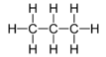
hydrogen bonds, are not drawn. When a molecule only has single bonds (sp3 bonds), these bonds are shown in a “zig-zag” pattern. This is due to the fact that all bonds in the tetrahedral geometry point as far apart as feasible, and the structure is not linear. Consider the following diagrams of the propane molecule:
It’s worth noting that hydrogens aren’t represented in skeletal structures. In the lack of double or triple bonds, carbon forms four total bonds, implying the presence of hydrogens. When the structure specifies an insufficient number of bonds to a carbon atom, the rest of the bonds are assumed to be made to hydrogens.
It is acknowledged that there are carbon atoms (with h3 joined ) at the terminal ends of the structure, but only the bonds are being dragged out.
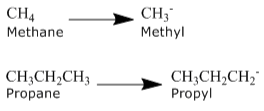
The formula CnH2n+2 can be used to characterise alkanes. The formula CnH2n+1 describes an alkyl group generated by removing one hydrogen from an alkane chain. When this hydrogen is removed, the stem changes as -ane to -yl. Take a look at the samples provided below.
Name | Molecular Formula | Condensed Formula |
Methane | CH4 | CH4 |
Ethane | C2H6 | CH3 CH2CH3 |
Propane | C3H8 | CH3 (CH2 )2CH3 |
Butane | C4H10 | CH3 (CH2 )3CH3 |
Pentane | C5H12 | CH3 (CH2 )4CH3 |
Hexane | C6H14 | CH3 (CH2 )5CH3 |
Heptane | C7H16 | CH3 (CH2 )6CH3 |
Octane | C8H18 | CH3 (CH2 )7CH3 |
Nonane | C9H20 | CH3 (CH2 )8CH3 |
Decane | C10H22 | CH3 (CH2 )9CH3 |
Undecane | C11H24 | CH3 (CH2 )10CH3 |
Dodecane | C12H26 | CH3 (CH2 )11CH3 |
Tridecane | C13H28 | CH3 (CH2 )12CH3 |
Tetradecane | C14H30 | CH3 (CH2 )13CH3 |
Pentadecane | C15H32 | CH3 (CH2 )14CH3 |
An alkane, often known as paraffin (a historical term with several meanings), is an acyclic saturated hydrocarbon in organic chemistry. To put it another way, an alkane is made up of hydrogen and carbon atoms organised in a tree structure with single carbon–carbon bonds. CnH2n+2 is the typical chemical formula for alkanes. The alkanes range in complexity from the simplest example of methane (CH4), where n = 1 (often referred to as the parent molecule), to arbitrarily big and complicated compounds, such as pentacontane (C50H102) or 6-ethyl-2-methyl-5-(1-methylethyl) octane, a tetradecane isomer (C14H30).



 Profile
 Settings
 Refer your friends
 Sign out