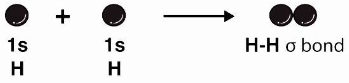
Valence bond theory is concerned with electronic configuration, atomic orbitals (and their overlapping), and atomic orbital hybridization. Atomic orbitals overlapping and electrons being concentrated in the matching bond region generate chemical bonds. The electrical structure of molecules created by this overlapping of atomic orbitals is also explained by the valence bond theory. It also emphasises how one atom’s nucleus is attracted to the electrons of the other atoms in a molecule.
The Lewis approach to chemical bonding failed to provide insight into how chemical bonds are formed. In addition, the valence shell electron pair repulsion theory (commonly known as VSEPR theory) had just a few applications (and also failed in predicting the geometry corresponding to complex molecules).
The valence bond hypothesis was proposed by German physicists Walter Heinrich Heitler and Fritz Wolfgang London to address these concerns. The Schrodinger wave equation was also used to explain the formation of a covalent bond between two hydrogen atoms. The valence bond hypothesis is used to depict the chemical bonding of two hydrogen atoms.
The main postulates of the valence bond theory are listed below:
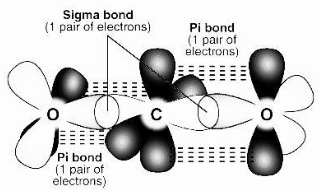
Below is a diagram of how sigma and pi bonds are formed.
It’s worth noting that sigma bonds include atomic orbitals overlapping head-to-head, whereas pi bonds involve parallel overlapping.
The valence bond theory has a number of flaws.
A wave function is a mathematical representation of a quantum state of a particle as a function of momentum, time, location, and spin in quantum physics. The Greek letter psi, ψ is used to represent a wave function.
The likelihood of locating an electron within the matter-wave can be explained using a wave function. This can be achieved by incorporating an imaginary number that is squared to create a real number solution resulting in an electron’s position. With the help of the Schrodinger equation, the concept of wave function was introduced in 1925.
The linear partial differential equation defining the wave function is known as the Schrodinger equation. Erwin Schrodinger is the name of the equation. Schrodinger could work on the wave function using quantum mechanics postulates.
The Schrodinger equation is written as follows
HΨ = EΨ
H = Hamiltonian operator
Valence electrons, which are present in the atom’s outermost occupied orbitals, may not necessarily stay in the same orbital or energy level because they can absorb energy from heat or light. When a valence electron absorbs enough energy, it reaches an excited state. The electron jumps from its original energy level or orbital, also known as the ground state, to an empty orbital of a higher energy shell that is further away from the nucleus. However, the excited electron does not remain in the excited state indefinitely, and eventually returns to the ground state.
The requirement of a maximum intersection, which hints at the establishment of the strongest conceivable bonds, is a key aspect of the Valence Bond theory. Many molecules employ this notion to describe the formation of covalent bonds. The Valence bond hypothesis is crucial because it aids in comprehending the concept of molecule bonding.



 Profile
 Settings
 Refer your friends
 Sign out