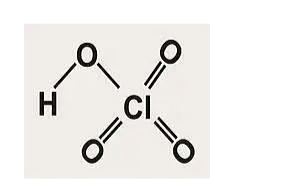
Perchloric acid is a naturally occurring mineral acid. This colorless chemical, which is usually found as an aqueous solution, is a stronger acid than sulfuric acid, nitric acid, and hydrochloric acid. When heated, it is a potent oxidant, however at ambient temperature, aqueous solutions up to about 70% by weight are normally harmless, with only strong acid characteristics and no oxidizing properties.
The formula for perchloric acid is HCLO4.
The structure is as follows:
NaClO4 + HCl → NaCl + HClO4
Ba (ClO4)2 + H2SO4 → BaSO4 + 2HClO3
3HClO3 → HClO4 + Cl2 + 2O2 + H2O
IUPAC Name | Perchloric acid |
Physical appearance | Clear, colorless, and odorless aqueous solution and corrosive to metals and tissues |
Chemical Formula | HClO4 |
Density of Perchloric acid | 1.768 g/cm3 |
Molecular weight of HClO4 | 100.46 g/mol |
Melting point of Perchloric acid | −17 °C |
Boiling point of Perchloric acid | 203 °C |
Aqueous pKa | −15.2±2 |
Perchloric acid has the following applications:
Perchloric acid is corrosive in nature. In the structure, one of the oxygen atoms forms a single bond with chlorine, while the other three oxygen atoms are linked to chlorine via a coordinate bond.Acidic acids are H+ proton-rich acids, whereas strong acidic acids are those with persistent conjugate bases. The negative charge conjugation produced on the oxygen atom and the other three oxygen atoms makes perchlorate ions stable.
Perchloric acid is heavily regulated due to its powerful oxidizing effects. It reacts violently with metals (such as aluminum) and biological materials (wood, plastics). To avoid the accumulation of oxidisers in the ductwork, work with perchloric acid must be done in fume hoods with a wash-down capability.
On February 20, 1947, a bath containing approximately 1000 liters of 75 percent perchloric acid and 25 percent acetic anhydride by volume burst in Los Angeles, California, killing 17 persons and injuring 150 more. The O’Connor Electro-Plating plant, along with 25 other buildings and 40 automobiles, was destroyed, and 250 nearby homes were damaged. In the bath, electro-polishing aluminum furniture was done. Organic compounds were added to the hot bath when an iron rack was replaced with one covered in cellulose aceto butyrate.The bath exploded a few minutes later.
Perchloric acid has the following health risks:
Anhydrous perchloric acid is an oily, unstable liquid at room temperature. It produces at least five hydrates, some of which have been discovered crystallographically. In these materials, hydrogen bonds bind the perchlorate anion to the H2O and hydronium ion centres. Perchloric acid reacts with water to generate an azeotrope, which contains 72.5 percent perchloric acid. This acid is readily available in stores and has an infinite shelf life. Hygroscopic solutions are those that are hygroscopic. If exposed to the air, concentrated perchloric acid dilutes by absorbing water from the air.



 Profile
 Settings
 Refer your friends
 Sign out