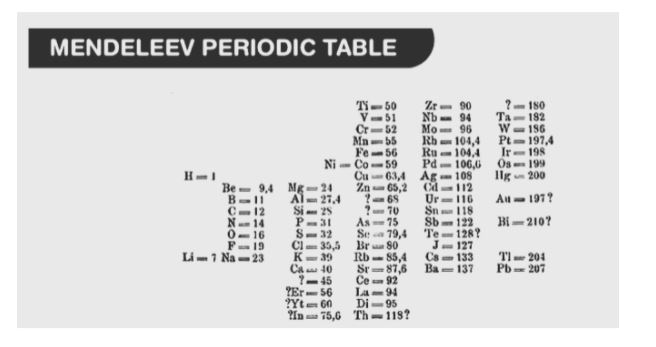
Mendeleev Periodic Table – As we all know, our periodic table contains 118 elements. 94 of these 118 elements are natural, while 24 are synthetic. Only 30 elements were known in 1800. With the discovery of new elements, scientists found it difficult to memorise the elements and their properties. They began collecting data on the elements and classifying them. The tabular classification of elements according to their qualities became widespread. The periodic table is a tabular arrangement in which various elements are grouped according to their properties.
The Mendeleev Periodic Table was created in 1869, following the rejection of the Newlands Octave Law. Mendeleev’s periodic table was organised according to the fundamental property, the atomic mass, and the chemical properties of the elements it contained. Only 63 elements were known at the time of Mendeleev’s research. Mendeleev discovered, after analysing the properties of each element, that the properties of elements were connected to atomic mass in a periodic manner. In order to ensure that elements with similar qualities were grouped together in the same vertical columns of the periodic table, he ordered the elements in a specific way.
Mendeleev considered the formulae of hydrides and oxides to be one of the most fundamental criteria for categorization when it came to chemical qualities. He made a deck of 63 playing cards, on which he wrote the properties of one element on each card. He categorised the elements based on their common characteristics and pinned them to the wall. He discovered that elements were grouped in increasing order of atomic mass and that atoms with comparable qualities recurred on a regular basis in the universe.
Mendeleev has stated the following law for the periodic table –
“The properties of elements are a periodic function of their atomic masses,” according to the definition.
Read more:
Periods are the horizontal rows that go across the page. During the formation of an atom, periods are defined as the relationship between orbitals, or the likely places in which electrons will be found, within the outermost shell of the atom. Successful periods down the table correspond to atoms having a more electron-rich core of inner shells, as shown by increasing electron density
Mendeleev’s periodic table has the following defects –
The periodic table is considered to be one of the most significant contributions to the discipline of chemistry. It is full of patterns that allow us to gain a deeper understanding of the environment in which we live. We would not have many of the items and medicines available to us today if it were not for it.



 Profile
 Settings
 Refer your friends
 Sign out