Red phosphorus is one of the most prevalent allotropes of phosphorus and is regarded to be a derivation of the P4 molecule, which is a phosphorus atom with four protons. Amorphous (non-crystalline) networks of phosphorus atoms support the formation of phosphorus. According to the findings, it is more stable than white phosphorus (another naturally occurring phosphorus allotrope). The rich red colour and granular texture of red phosphorus distinguish it from other types of phosphorus.
The allotrope of red phosphorus is formed through the slow transition of white phosphorus. In the presence of light and energy in the form of heat, this transformation occurs more quickly. It is characteristically yellow in colour when a sample of white phosphorus has been largely transformed into red phosphorus via a reaction.
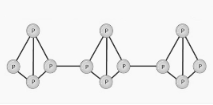
In the presence of red phosphorus, a polymeric chain of tetrahedrally structured P4 molecules forms, in which one of the P-P bonds has been broken, allowing for the connecting of these tetrahedrons. The chemical structure of red phosphorus is depicted in the diagram below.
According to the image shown above, the structure of red phosphorus is pretty similar to the structure of a P4 molecule in terms of symmetry. Each phosphorus atom in P4 is bonded to three other phosphorus atoms in a tetrahedral form, which is the most stable structure known. In the event that one of these links is broken, these tetrahedral structures can proceed to form bonds with nearby P-atoms, resulting in the formation of a polymer-like structure in the process.
Red phosphorus is colourless and odourless, and it has a rich red hue. In contrast to the white phosphorus allotrope, this allotrope is not toxic to human beings. It is crystallised when red phosphorus is heated to temperatures greater than 300 degrees Celsius. In its crystal lattice, it can also take on the shape of a cubic structure.It has a longer shelf life than white phosphorus.The molar mass of this compound is 30.974g/mol.It is classified as an amorphous solid.It has a melting point of 860 degrees Celsius.It has a density of 2.34 grammes per cubic centimetre.
This particular allotrope of phosphorus does not show any signs of phosphorescence (a type of photo luminescence). It should be noted that red phosphorus is less chemically reactive than its white phosphorus equivalent.
When Anton von Schrotter, an Austrian chemist, heated white phosphorus to 300 degrees Celsius, he discovered red phosphorus for the first time. Other major methods of obtaining red phosphorus are explored in greater detail in this section..
The red phosphorous and powdered glass that make up the striking surface of a matchbox are used to make it strike. Using this mixture, you can create a spark powerful enough to light a matchstick or lighter. The following are some of the other notable applications for red phosphorus.
Red phosphorus is one of the most prevalent allotropes of phosphorus and is regarded to be a derivation of the P4 molecule, which is a phosphorus atom with four protons. Amorphous (non-crystalline) networks of phosphorus atoms support the formation of phosphorus. The allotrope of red phosphorus is formed through the slow transition of white phosphorus. In the presence of light and energy in the form of heat, this transformation occurs more quickly. It is characteristically yellow in colour when a sample of white phosphorus has been largely transformed into red phosphorus via a reaction. This allotrope of phosphorus is utilised in the ignition process of many flares, which are employed as emergency signals in many situations. Using this allotrope, it is also possible to maintain the flame’s combustion for an extended period of time. Aside from its usage as a flame retardant in thermoplastics and thermosetting polymers, red phosphorus has other applications.



 Profile
 Settings
 Refer your friends
 Sign out