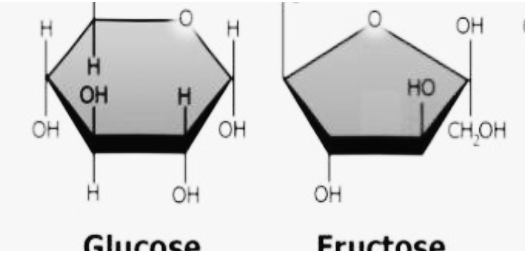
Fructose is a ketonic monosaccharide. Monosaccharides are the basic units of carbohydrates that cannot be broken down further. They are classified by the carbohydrate’s functional group.
An aldose contains an aldehyde group, while a ketose contains a ketonic group. Also known as fruit sugar. Fructose, glucose, and galactose are all monosaccharides found in human diet.
Fruit sugar was discovered by Augustin-Pierre Debrunfaut. Most root vegetables and vine and tree fruits contain it. It typically disaccharides with sucrose. This sugar is made from corn, sugar cane, and sugar beets. Excessive consumption can lead to obesity and insulin resistance.
Chemical Formula: C6H12O6
Thus, D-fructose exhibits stereoisomerism in which α-D-fructopyranose and β-D-fructopyranose are the isomers.
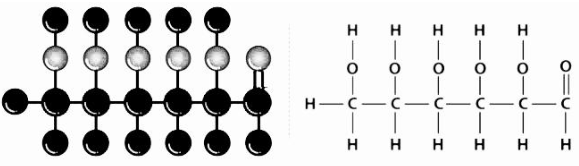
Sugar having six carbon atoms and one aldehyde group, glucose is a simple sugar with no further chemical constituents. Monosaccharide with the chemical formula C6H12O6 is what we’re talking about.
It is also referred to as dextrose. It is referred to as aldohexose due to the fact that it has 6 carbon atoms and an aldehyde group in its structure. It can be opened in two different ways: as an open-chain structure or as a ring structure. Animals’ livers and kidneys are responsible for its production. It can be found in plants in a variety of forms, including fruits and other portions of the plant. D-glucose is the type of glucose that occurs naturally in the body. In either solid or liquid form, it is possible to come upon this substance.
C6H12O6 | Glucose |
Molecular Weight/ Molar Mass | 180.16 g/mol |
Density | 1.54 g/cm³ |
Melting Point | 146 °C |
Simple sugar | Monosaccharide |
Sugar can be referred to either aldohexose or dextrose, depending on the context. It is a monomer of many bigger compounds, such as carbohydrates, starch, and cellulose, and it has a crystalline structure. This is the organic substance that is found in the greatest quantity on the planet. It was determined that the structure depicted above was appropriate based on the evidence presented below:
Fructose, popularly known as fruit sugar, is the only ketohexose that occurs naturally in the body. It is also referred to as levulose because it possesses a significant levorotatory optical rotation, which makes it a good candidate for this designation.
Glucose is the monosaccharide with the greatest abundance. Glucose is also the aldohexose that is most commonly found in the bodies of most living species. The fact that glucose has a lower potential than other aldohexoses to react nonspecifically with the amine groups of proteins could be one explanation for this. Glycation is a chemical reaction that weakens or destroys the activity of numerous proteins, as shown, for example, in glycated haemoglobin.



 Profile
 Settings
 Refer your friends
 Sign out