This law was named after the French Chemist Gay Lussac, who discovered the relationship between the pressure of a gas and its absolute temperature. Gay Lussac’s law of Thermodynamics state that when the volume is held constant, the pressure of the given mass of gas varies directly with the gas’s absolute temperature. The kinetic energy of the molecules of the gas increases, which in turn hits the walls of the container with greater force, resulting in greater pressure. Mathematically, it can be written as P/T=k. It is a special case of ideal law gas. This law is also commonly known as the Pressure Law or Amontons’s Law.
P∝T (Volume constant)
Removing the proportionality-
P=kT —(1)
(here P= Pressure exerted by the gas
k= constant
T= absolute temperature of the gas)
For Ideal Gas Equation-
PV=nRT —(2)
Substituting the value of P from equation (1) to (2)-
kTV=nRT
k=nR/V
k∝1/V —(3)
From the above equation, we see that when volume will increase and k(constant) will decrease.
The law can be written as follows for comparing the same substance under two different sets of conditions:
P1 T2 = P2 T1
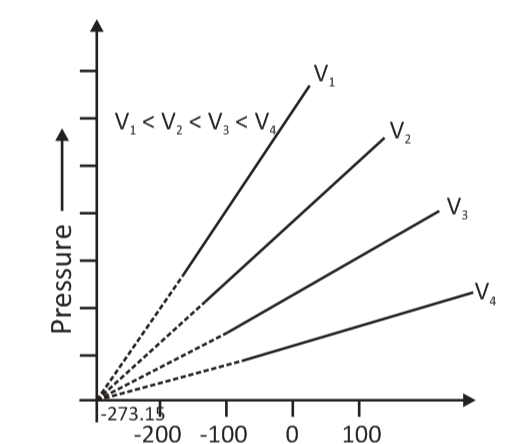
The graphical representation of this law is also known as the P-T graph. The graph is drawn by taking the absolute temperature on the x-axis and pressure on the y-axis. This relation is called the pressure-time relation. The slope in this graph represents k(constant) and is inversely proportional to the volume. Therefore, if we increase the volume, the slope will decrease. Here, it is given that V1 < V2 < V3 < V4 and the graph can be represented as follows:
The graph illustrates that the pressure of gas kept at a constant volume constantly decreases as it cools until the gas eventually condenses and becomes a liquid.
The law of combining volumes states that when gasses react with each other, they react in volume, which takes up a simple whole-number ratio, provided that the temperature and pressure of the reacting gases remain constant.
Statement- The ratio between the volumes of the reactant gasses and the gaseous products can be expressed in simple whole numbers.
For example, Gay Lussac discovered that two molecules of hydrogen combine with one molecule of oxygen to form two molecules of water. Based on these results, Amedeo Avogadro assumed that the same amount of gas contains the same number of molecules at the same temperature and pressure. This hypothesis can be expressed as:
2 molecules of hydrogen + 1 molecule of oxygen = 2 molecules of water.
Therefore, the volumes in which hydrogen and oxygen combine bear a simple ratio of 2:1.
Joseph-Louis Gay Lussac is a French chemist and physicist. He initiated the study into the behavior of gasses and developed new techniques in the analysis and experimentation of the same, which led to notable advances in the field of applied chemistry. He was born on December 6, 1778 in France. Gay Lussac’s first publication came out in 1802, which dealt with the thermal expansion of gases. He used dry gasses and mercury for error-free results in the experiment. From the experiment that he performed, he concluded that all gasses expand equally in the temperature range of 0-100 ° C. This law is usually attributed to the “Charles Law.” These were the first of several regularities in the behaviour of matter that Gay Lussac established. Gay Lussac’s with his friend Louis Jacques Thenard, identified a class of substances (later called carbohydrates) such as sugar and starch that contained a 2: 1 ratio of hydrogen and oxygen. They published the results in the form of three laws, depending on the ratio of hydrogen to oxygen in the substance.
We learned about Gay Lussac’s Law of Thermodynamics. It is an important study to learn about the behavior of ideal gasses. Gay Lussac law has application in real life too. The significance of this gas law is that it shows that increasing the temperature of a gas causes a relative increase in its pressure (assuming that the volume does not change). Similarly, decreasing the temperature causes the pressure to decrease proportionally.



 Profile
 Settings
 Refer your friends
 Sign out