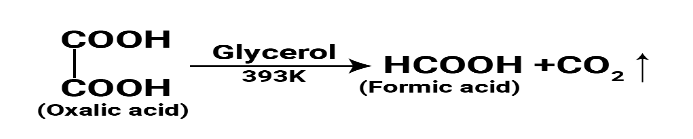
Let us first understand what acid is. An acid is a chemical compound that releases H+ ions in an aqueous solution. We can test the acidic or basic nature of a compound by using an acid-base indicator. Formic acid comes in the carboxylic acid group. It is written as HCOOH and formic acid is the first member of the carboxylic acid group. Formic acid is also known as methanoic acid. Formic acid was first isolated from certain ants and was named after the Latin Formica, meaning “ant”.
Formic acid is the simplest form of carboxylic acid and is also known by the systematic IUPAC name as methanoic acid. It is formed naturally in the venom of bees and ants and is considered an important intermediate in chemical synthesis. The chemical formula of formic is HCOOH.
The structure of formic acid is simple. It is the simplest carboxylic acid that contains 2 oxygen atoms, a single carbon atom, and 2 hydrogen atoms.
Formula: CHOOH
IUPAC name: Formic acid.
Molar mass: 46.03g/mol
Density: 1.22g/cm
Boiling point: 100.8c
Melting point: 8.4 c
Special reaction for methanoic acid:
HCOOH + NaOH → HCOONa + H2O
HCOOH + H2SO4 → H2O + CO
HCOOH → CO2 + H2
Formic acid may be obtained as follows:
Firstly, a strong acid is an acid that disassociates completely in an aqueous solution. Whereas a weak acid dissociates partially in an aqueous solution. Hence by this property, we can say that formic acid is a weak acid and it occurs naturally in stings of bees and ants. Formic acid can also form by the distillation of ants.
Formic acid is the simplest form of organic acid comprising a hydrogen atom bonded to the carboxylic acid functional group. The structural formula of methanoic acid determines its physical and chemical properties. It is a naturally occurring acid found in the venom of ants. Due to its anti-bacterial properties, it is highly used in agriculture industries.



 Profile
 Settings
 Refer your friends
 Sign out