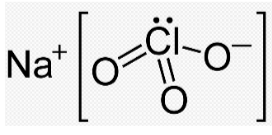
When sodium chloride reacts with oxygen it produces an inorganic substance having the chemical formula NaClO3, and it is found in nature in White crystalline powder that is readily soluble in water, it has a sweet taste to it. It has a hygroscopic property. It decomposes at temperatures exceeding 300 degrees Celsius, releasing oxygen and leaving sodium chloride behind. The product is produced in large quantities, with several hundred million tons produced annually, mostly for use in bleaching pulp to generate high-brightness paper. It is possible to chlorinate aromatic compounds without the need of organic solvents by combining sodium chlorate with hydrochloric acid (or with sulfuric acid and sodium chloride, the reaction of which yields HCl). If the pH is high enough, it will oxidize the HCl to produce either HOCl or Cl2 (depending on the pH), which are the active chlorinating agents.
One of its physical characteristics is that it is white in color and that it is crystalline in nature, meaning that it dissolves quickly in water. In nature, it has been observed to be hygroscopic (capable of absorbing moisture from the surrounding air). It decomposes at a temperature of 573 degrees Kelvin, releasing O2 and leaving behind NaCl. The production of sodium chlorate is substantial each year, with the majority of it going into the oxidizing mash, which is used to produce high-quality paper.
In order to make sodium chlorate, salty water is electrolyzed (sodium chloride and water)
NaCl + 3 H2O + 6 e– → NaClO3 + 3 H2
An exothermic reaction is at work here. It’s a series of events. The technique can also be affected by changes in pH and temperature.
Chlorine gas (Cl2) is stored at the anode and hydrogen gas (H2) is stored at the cathode in the manufacture of sodium chlorate. The hypochlorite anion group formed as a result of chlorine’s hydrolysis in the cell yields sodium chlorate.
There are a lot of crystals in sodium chlorate. Cell liquor is a term used to describe the hydrolyzed solution. Remove the solution from the device. After they’ve been cleaned and dried, the crystals can be stored in a dry location. It can be sold in crystals or as a liquid, depending on the intended usage. To produce 1 mol of chlorate, 6 mol of chloride must be discharged, regardless of the reaction pathway. In contrast, the anodic oxidation method requires 50% more electricity. Autoxidation is hence the preferred mechanism for industrial cells. In order to minimize loss reactions, chlorate production at the anode is considered to be a loss reaction.
There are a lot of inorganic salts out there, and sodium chlorate has a lot of the same physical properties. Some of them are on the list below.
Sodium chlorate is utilised in a wide variety of applications. Several common applications are listed here.
When aqueous sodium chloride is electrolyzed, sodium hypochlorite, or NaOCl, is formed, which is a sodium, oxygen, and chlorine compound used in large quantities in household chlorine bleach. Sodium hypochlorite is also used as an antibiotic and fungicide in certain pharmaceutical formulations, as well as an industrial bleach for paper pulp and textiles and water chlorination. It is a highly unstable chemical that can only be found in aqueous solution. Other notable commercial applications of sodium chloride include electrolytic decomposition for the generation of chlorine and sodium hydroxide, as well as the Solvay method for the manufacturing of sodium carbonate (Na2CO3).



 Profile
 Settings
 Refer your friends
 Sign out