Ascorbic acid is a common food additive since it is both a vitamin and a natural preservative. Plants require ascorbic acid as well. As the most abundant water-soluble antioxidant in plants, it not only aids in photosynthesis, cell development, and signal transduction, but it also aids in the antioxidant defense. Food chemists and botanists have conducted the great bulk of investigations on ascorbic acid oxidation chemistry due to its role in food and plants.
Ascorbic acid is a prevalent and significant chemical in mammalian systems, with involvement in metabolic activity, oxidative stress responses, and immune system maintenance occurring in epithelial lung lining fluid and other body areas.
L-Ascorbic Acid, or simply Ascorbic Acid, is the chemical name for pure Vitamin C. As passing through polarized plane light, “L” relates to the molecule’s unique 3–D structure and rotation orientation. Vitamin C, often known as ascorbic acid, is a water-soluble vitamin found in nature. L-ascorbic acid is a crystalline powder with a strong, acidic taste and a white to very pale yellow colour.
Hexuronic acid, commonly referred as ascorbic acid, is an organic compound with the formula C6H8O6. It’s a white substance that, in polluted samples, can seem yellowish. It dissolves easily in water and generates somewhat acidic solutions. It has a mild reducing effect.
Ascorbic acid has two enantiomers (mirror-image isomers): “L” (for “levo”) and “d” (for “dehydroascorbic acid”) (for “dextro”). The l isomer, that occurs naturally in many foods and is 1 form (“vitamer”) of vitamin C, is the most prevalent isomer. Vitamin C is a vital nutrient for humans and many animals. Scurvy is caused by a vitamin C deficiency, which was once a common ailment among sailors on lengthy sea voyages. It’s a popular culinary ingredient and dietary supplement because of its antioxidant properties.
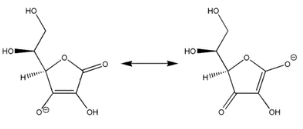
Whenever deprotonated on one of the hydroxyls, ascorbic acid generates the ascorbate anion, which is a vinylogous acid. This behavior is found in reductones, which are enediols that have a carbonyl group next to the enediol group, including the group -C(OH)= C(OH)-. Electron delocalization caused by resonance between two forms stabilises the ascorbate anion.
As a consequence, ascorbic acid is substantially more acidic than would be expected if only isolated hydroxyl groups were present.
Sodium ascorbate, calcium ascorbate, and potassium ascorbate are salts of the ascorbate anion.
Ascorbic acid can also produce esters including ascorbyl palmitate and ascorbyl stearate whenever it reacts with organic acids as an alcohol.
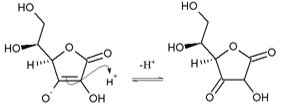
Ascorbic acid’s nucleophilic reaction on a proton produces a 1,3-diketone:
Vitamin C is an acid, as its name implies. It means adding ascorbic acid to water will make the water slightly sour and lower the pH below 7. It accomplishes this (as does any acid) by raising the proton (H+) content in the water. Vitamin C’s chemical formula is C6H8O6.
Despite the fact that vitamin C can be found in fruits and vegetables, it must be produced artificially in laboratories and industries to supply the pharmaceutical industry’s growing demand. With D-Glucose as the starting material, ascorbic acid is synthesised industrially employing a combination of chemical and microbiological techniques. The Reichstein procedure is the name for this method.
It’s a weak, water-soluble, unstable organic acid that’s easily oxidised or dissolved by light, oxygen, high temperatures, alkali, humidity, copper, and heavy metals. Ascorbic acid is typically found as a crystalline powder that is white or slightly yellow in colour.
Use the powder with products that include water, including serums, essences, and lotions. Because vitamin C is water-soluble, it’s preferable to mix it with light, watery textures until it dissolves. Aim for a 20% concentration or less, which translates to around 1 part powder to 4 parts product.
Vitamin C’s chemical name is ascorbic acid. C6H8O6 is its chemical formula. Monosaccharides, including glucose, are used to make it. Since vitamin C is water-soluble, it is critical to consume it on a regular basis because it is neither made nor stored in the body. On a molecular level, vitamin C is required for daily metabolic activities in our bodies since it acts as an electron donor for numerous enzymes. Ascorbic acid exhibits intramolecular hydrogen bonding. Vitamin C is an essential vitamin for humans since it boosts immunity and protects the blood vessels, eyes, skin, and heart. In serums, essences, and lotions, mix the powder in with the water. Because vitamin C is a water-soluble vitamin, it usually works whenever mixed with light, watery textures until it dissolves.



 Profile
 Settings
 Refer your friends
 Sign out