Free radicals are highly reactive and unstable molecules that are produced in the body naturally as a byproduct of normal metabolism, or by exposure to toxins in the environment such as tobacco smoke and ultraviolet light. Free radicals have a lifespan of only a fraction of a second, but during that time can damage DNA, sometimes resulting in mutations that can lead to various diseases, including heart disease and cancer. Antioxidants in the foods we eat can neutralize the unstable molecules, reducing the risk of damage. The free radicals are produced during ATP through mitochondria. They are generally divided into two well-known entities: reactive oxygen species and reactive nitrogen species.
Free radicals are the products of normal cellular metabolism. A free radical can be defined as an atom or molecule containing one or more unpaired electrons in a valence shell or outer orbit and is capable of independent existence. The odd number of electron(s) of a free radical makes it unstable, short-lived, and highly reactive. Because of their high reactivity, they can abstract electrons from other compounds to attain stability. Thus the attacked molecule loses its electron and becomes a free radical itself, beginning a chain reaction cascade that finally damages the living cell Both ROS and RNS collectively constitute the free radicals and other nonradical reactive species.
What Are Free Radicals?
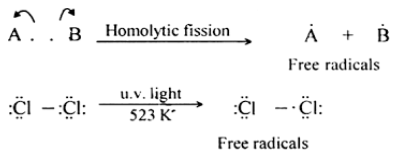
Chemical species having one or more unpaired electrons are called free radicals. Homolytic bond fission leads to the formation of free radicals. The free radicals are odd electron molecules and are highly reactive. Free radicals are paramagnetic in that they possess a small permanent magnetic moment due to the presence of unpaired electrons. This property is used for the detection of the presence of free radicals.
Structure of Free Radicals
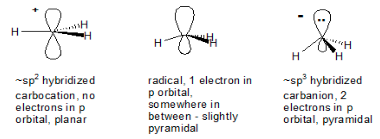
An organic free radical is a free radical form of carbon with three bonds and a single, unpaired electron. A free radical can react with another free radical, but more often it reacts with a stable, evenly paired molecule. Carbon-containing an unpaired electron in free radicals also may either be in an Sp2 hybrid state in which the structure is planar with an odd electron in the p orbital or it could be Sp3 hybridized which could make the structure pyramidal.
Stability of Free Radicals
The various factors responsible for the stability of free radicals are the Inductive effect, Hyperconjugative effect, and Resonance effect.
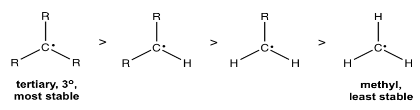
Inductive effect Greater the number of alkyl groups attached to the free radical carbon center will be the stability of the radical. This is due to the electron-donating inductive effect of the alkyl groups which decreases the electron deficiency of the radical.
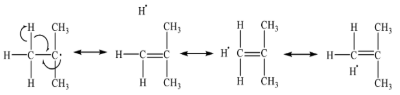
Hyperconjugation effect: Hyperconjugative effect also gives stability to free radicals as in the case of carbocations. The stability order of alkyl free radicals is tertiary >secondary > primary > CH3. This stability order can be explained by hyperconjugation. The odd electron in the alkyl radical is delocalized onto the β-hydrogens, through hyperconjugation, which confers stability to the radical. Thus, tert-butyl radical is more stable than sec-butyl radical which in turn is more stable than n-butyl radical.
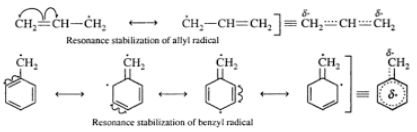
Resonance Effect: In the free radicals where the carbon center is in conjugation to a double bond, the resonance effect leads to the stabilization of these molecules. The stabilizing effects of vinyl groups (in allyl radicals) and phenyl groups (in benzyl radicals) are very significant and can be satisfactorily explained by resonance. Allyl and benzyl free radicals are more stable than alkyl free radicals but still have only a transient existence under ordinary conditions
Reactions of Free Radicals
The most common reactions of free radicals are the substitution and addition, for example, halogenation of alkenes in the presence of light and the addition of HBr in the presence of peroxide.
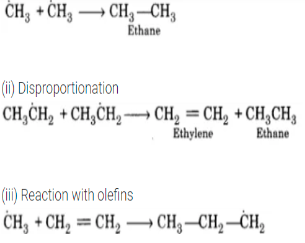
Recombination reaction: the free radicals may recombine to form hydrocarbons.
Disproportionation reaction: At higher temperatures, the alkyl radical may undergo disproportionation. The ethyl radical disproportionates that one radical CH3CH2 takes up hydrogen from another free radical to give ethylene and ethane.
Reaction with Olefins: The alkyl radicals react with olefins to form new free radicals.
Uses of Free Radicals
These highly reactive structures are present in the membranes of cells of damaging biologically relevant molecules such as DNA, lipids, proteins, carbohydrates, etc.
The free radicals attack important macromolecules which lead to cell damage and homeostatic disruption such as proteins, nucleic acids, etc.
Generally alkyl halides or aryl halides are used as radical precursors for R or Ar however halogenation of sugars and nucleosides which have many OH groups and other delicate functional groups is rather difficult.
Other thiocarbonyl derivatives formed from alcohols with phenoxythiocarbonyl chloride, diimidazole, etc can also be used instead of methyl xanthate.
Conclusion
A balance between free radicals and antioxidants is necessary for proper physiological function. If free radicals overwhelm the body’s ability to regulate them, a condition known as oxidative stress. Free radicals can steal electrons from lipids, proteins, and DNA causing them damage. Antioxidants in the foods we eat can neutralize the unstable molecules, reducing the risk of damage. Because of their high reactivity, they can abstract electrons from other compounds to attain stability.



 Profile
 Settings
 Refer your friends
 Sign out