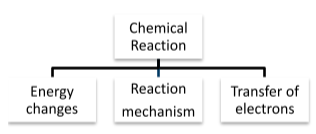
A chemical reaction occurs when one or more than one chemical, which is also termed reactants, are changed into one or more distinct substances, referred to as products. Chemical elements and compounds are both substances.
Example:-Sodium acetate, carbon dioxide, and water are formed by mixing vinegar with baking soda.
Likewise, there are so many different types of reactions, that it becomes important for us to classify them. Let us understand the different types of chemical reactions.
The reactants can be defined as the substances which react during a chemical reaction, and the products can be defined as the chemicals that are created during a chemical reaction.
For example, Rust is caused by the reaction between iron and oxygen.
Sodium acetate, carbon dioxide, and water are formed by mixing vinegar with baking soda.
Endothermic Reactions are those types of reactions in which the body produces heat. The term “endothermic reaction” means to respond in which a system absorbs energy from its surroundings in the form of heat. Melting ice, dry ice, alkanes cracking, Photosynthesis, evaporating liquids, thermal decomposition, ammonium chloride in water, and many other endothermic processes are examples.
It is the opposite of an endothermic reaction. Exothermic Reaction gives off energy to their surroundings in the form of heat or light. Neutralization, burning of a substance, fuel reactions, deposition of dry ice, respiration, sulfuric acid solution in water, and many more processes are examples.
A combination reaction is one in which two or more reactants merge to generate a single product. It is popularly known as synthesis reaction. It is expressed as X + Y → XY
Combination reaction example 2Na + Cl2 → 2NaCl
A decomposition reaction occurs when a single chemical breaks down into two or smaller compounds.
It has the shape of XY → X + Y
The decomposition reaction is the opposite of a combination reaction.
A decomposition reaction might look like this CaCO3 → CaO + CO2
A thermal decomposition reaction occurs when a chemical decomposes which is the heating.
A chemical process in which a more reactive element is displaced from its aqueous salt solution and replaced by a less reactive element is called a displacement reaction.
It’s written as X + YZ → XZ + Y
A substitution reaction is another name for it.
Zn + CuSO4 → ZnSO4 + Cu
A double displacement reaction can be defined as the chemical process in which ions are Interchanged between two reactants to generate a new molecule.
It is written as XY + ZA → XZ + YA
BaCl2 + Na2SO4 → BaSO4 + 2NaCl this is the example of the above reaction, double displacement reaction.
The loss of a hydrogen atom is referred to as oxidation, whereas the gain of a hydrogen atom is referred to as reduction. The production of ethanal from ethanol is an example of an oxidation reaction
CH₃CH₂OH → CH₃CHO
Redox is a term that combines the keywords reduction and oxidation. Redox reaction is a type of chemical reaction that includes the transfer of electrons between two substances. Both oxidation and reduction occur simultaneously in these processes.
A chemical reaction is a process defined by a chemical change in which the reactants (starting materials) differ from the results. Chemical reactions are characterized by the movement of electrons, which results in the creation and breaking of chemical bonds. There are several types of chemical reactions and more than one way to describe them.



 Profile
 Settings
 Refer your friends
 Sign out