Amine is a known ammonia derivative in organic chemistry. Chemically, it is a type of organic nitrogen molecule that has a lone pair of electrons in each nitrogen atom it contains. In other words, the hydrogen in amines is replaced by a group of alkyl or aromatic hydrocarbons. Aliphatic and aromatic amines are both types of amines. However, they are classed differently. Additional subgroups are defined by the number of carbon atoms linked to nitrogen, the number of hydrogens replaced and amines.
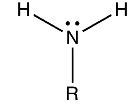
When one of the three hydrogen atoms in ammonia is replaced with an alkyl or aromatic group, the result is a primary amine. Amino acids and methylamine are examples of primary alkylamines, while aniline is a primary aromatic amine.
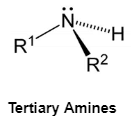
Two organic substituents (alkyl or aryl or both) are attached to the nitrogen by one hydrogen in secondary amines. Dimethylamine and aromatic Amine, such as diphenylamine, are two examples.
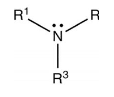
Nitrogen with three organic substituents is known as a tertiary amine. Trimethylamine and EDTA are two examples of tertiary Amines.
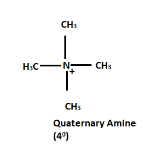
The nitrogen of quaternary amines includes four organic substituents, giving them a positive charge.
Another class of amines is known as “cyclic,” which is defined by how the nitrogen-linked substituents connect to each other. Cycles of ammonia can be secondary or tertiary, depending on the structure. Piperidine and aziridine are two examples of six- and three-membered rings.
The structure of amines has a nitrogen atom that is sp3-hybridized. The lone pair of electrons in the fourth sp3 hybrid orbital create sigma bonds with three other sp3 hybrid orbitals. The non-bonding lone electron pair points to the vacant corner of a tetrahedron in single-bonded nitrogen’s trigonal pyramidal form.
It is common to categorize the structure of amines into groups based on the settings in which they attach. Primary amines are amines in which an alkyl or aromatic group replaces one of the three hydrogen atoms. Secondary amines have two substituents and one hydrogen linked to a nitrogen atom in their structure. Organic substituents replace the hydrogen atoms in tertiary amines, which are amines with no hydrogen left. As the last point, cyclic amines are those in which the nitrogen has been integrated into a ring structure, effectively making it either secondary or tertiary amine. A nitrogen atom, one electron pair, and three substituents make up the basic structure of an amine. Having four organic substituents on the nitrogen, on the other hand, results in a charged nitrogen center in the form of an ammonium cation.
Final Words
Amine is a nitrogen atom with a lone pair of electrons and three substituted atoms in its general structure. A positive charge on the nitrogen atom can be achieved by binding to four different substituents. It’s possible that these charged species can be used in crucial steps in reactions.
An amine is a primary chemical since it has only one pair of electrons. Compound basicity can be affected by adjacent atoms, steric bulk, and solubility of the cation to be generated. As a result of their ability to form hydrogen bonds, amine compounds are water-soluble and have high boiling temperatures.



 Profile
 Settings
 Refer your friends
 Sign out