

 Profile
 Settings
 Refer your friends
 Sign out


Introduction
In eukaryotic organisms, linkage and crossing over are two related but distinct events. The tendency of genes to stay together on a chromosome is known as genetic linkage while crossing over is a phenomenon in which genetic information is exchanged in the germline. Both these factors have a significant impact on heredity. And both are connected in some way.
Linkage, on the other hand, refers to the tendency of genes on a chromosome to be inherited together. The genes separate and segregate into various gametes as a result of crossing over.
Here, we’ll learn more about genetic linkage and crossing-over definitions as well as the differences between the two.
Genetic Linkage
Genetic linkage, as previously stated, relates to the possibility of genes or DNA sequences in a chromosome being inherited together during meiosis stage of sexual reproduction. The genes that are linked are those that are found on the same chromosome. For example, take the genes that influence hair and eye colour. That is why some people have the same hair and eye colour. For example, you can consider those with black hair and brown eyes, inherited from their parents, or people with brown hair and blue eyes inherited from their parents.
Significance of Linkage
1. Linkage prevents breeders from combining attractive traits into a single variety.
2. Because linkage prevents recombination, linked characters are retained for generations.
In genetics, a linkage group is made of all the genes on a dedicated chromosome. They are acquired as a unit, which means they work and move as a unit throughout cell division, rather than independently. ,.of the existence of linkage groups, some features do not follow Mendel’s law of independent assortment (recombination of genes and the traits they govern), which states that the principle only applies if genes are on different chromosomes. When the chromosome breaks and the sections reunite with the companion chromosome, if it has broken in the same places, the gene content of the chromosome can change. Crossing over refers to the transfer of genes between chromosomes.
Crossing Over
Cross over occurs when non-sister chromatids swap chromosomes to create gametes. Crossing over shuffles the alleles on parental chromosomes, resulting in gametes that carry a mix of mother and father’s DNA. In layman’s terms, it’s the exchange of genetic material in the germline.
Pairs of chromosomes align during meiosis or the creation of egg cells and sperm cells so that similar DNA sequences from the paired chromosomes come up against one another. This mechanism is responsible for genetic variation in sexually reproducing organisms and is also required for correct chromosome segregation.
Mechanism of Crossing Over
Here are the linkage and crossing over classifications:
- Synapsis: The maternal and paternal homologous chromosomes move close to each other and begin pairing along their lengths during the zygotene substage of prophase I. Synapsis is the joining of homologous chromosomes. Bivalents are homologous chromosomes that have been coupled. Crossing over is based on mechanical principles.
- Duplication of Chromosomes: The synapsis is preceded by chromosome duplication. The chromatids of each homologous chromosome divide lengthwise and create two identical sister chromatids during the pachytene substage of prophase I. Tetrad refers to the fact that each bivalent includes four chromatids.
- Crossing Over: At one or more locations, the non-sister chromatids of a homologous pair twist over each other. Due to the action of the enzyme, the chromatid segments split at the relevant locations, and the segment of one side merges with the segment of the opposing side. As a result, chromatid segment breakage, transposition, and fusion are all part of the crossing over process.
- Chiasmata Formation: Chiasmata are the places where two homologous chromosomes join and cross across. The number of chiasmata is proportional to the length of the chromosomes; the longer the chromosomes, the higher is the number of chiasmata. Crossing over can occur at one or more points in a tetrad, resulting in the production of one or more chiasmas.
- Terminalisation: The non-sister chromatids begin to resist each other after crossing over due to a lack of attraction force between them. The chromatids are repelled from the centromere to the chiasma, and the chiasma itself travels in a zipper pattern towards the tetrad’s end. Terminalisation is the migration of the chiasma, and the homologs are entirely separated due to terminalisation.
The Difference between Linkage and Crossing Over
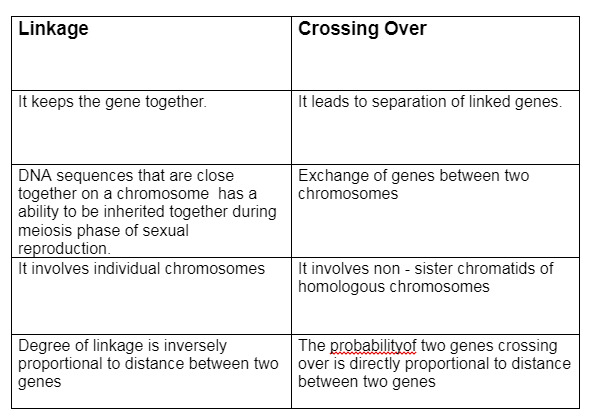
The process of separating genes across homologous pairings into distinct gametes is known as crossing over. The tendency to inherit genes on the same chromosome is known as linkage.
When two genes on the same chromosome are closer to each other, this is known as linkage. Crossing over, on the other hand, occurs when two genes on the same chromosome are far apart.
Crossing over may cause the gene groups formed via linkage to be disrupted.
Crossing over occurs exclusively during the prophase of meiosis I, unlike the linkage, and it results in recombinant alleles, which is not the case in linkage.

Conclusion
Hopefully, these notes will help you in comprehending the primary topics and recalling the exam’s most important parts. All the genes on a chromosome are said to be linked to one another . The process of inheritance of linked genes in the same linkage group is termed as linkage. The crossing over provides origin of new characters due to the exchange of a segment from one chromosome to another and thus it is a source of genetic variation Whereas linkage reduces the possibility of variability in gametes unless crossing over occurs.

