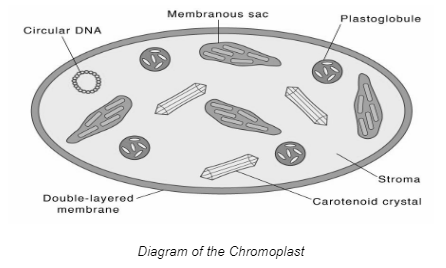
Plastids are a distinctive feature of plant cells. They synthesise and store food in algal and plant cells. All plastids begin as proplastids and mature into a variety of specialised mature plastids depending on the function of the cell. Mature plastids can even transition between different forms.
These are pigment-producing and pigment-storing plastids. Carotene and xanthophylls are found in them. Chromoplasts are the pigments that give leaves, fruits, flowers, and vegetables their hues. They produce hues other than green. These are found in flowers and ripe fruits. Additionally, chromoplasts aid in the pollination and dissemination of seeds.
Characteristics of Chromoplasts
Chromoplasts can be separated and categorised into four distinct varieties using a light microscope. The first kind is formed of granulated proteic stroma. The second is made up of protein crystals and granules of amorphous pigment. The third kind is made up of crystals of protein and pigment. The fourth form is a chromoplast composed entirely of crystals. An electron microscope provides more details, allowing the identification of substructures such as globules, crystals, membranes, fibrils, and tubules. The substructures of chromoplasts are absent from the mature plastid from which they separated.
Essentially, chromoplasts are heterogeneous plastids. They are categorised into four categories based on their carotenoid content:
Plastids are required for a wide variety of typical plant cell processes and so come in a variety of forms. Plastids are classified by their colour, shape, and ultrastructure (Whatley 1978; Miller 2005; Wise 2007). The chloroplast is a photosynthetic plastid so named because of its green colour. Non-photosynthetic plastids can be generically classified according to their pigmentation into leucoplasts, which are ‘white’ or colourless plastids, and chromoplasts, which are coloured plastids known for their accumulation of carotenoids. Amyloplasts, elaioplasts, etioplasts, and proplastids are all types of leucoplasts.



 Profile
 Settings
 Refer your friends
 Sign out