Motion is a part of classical mechanics. Motion can be understood as a change in the orientation of a body over time. The term “translation” refers to a movement along a straight line or a curve. Rotation is also a motion that changes a body’s orientation. All places within the body have the same velocity (directed speed) and thus the same acceleration in both circumstances (time rate of change of velocity). Translation and rotation are combined in the most basic universal quiet motion. Read through this article to know about the definition of motion, laws of motion, and the role of the equation of motion in calculations.
A Motion is a concept that depends on the frame of reference up to many extents. The observer and the objects are all at some position with a particular frame of reference. The observer is the one who is taking notes of the positions of the object from a frame of reference. The motion in the object is seen by attaching a frame of reference to the observer and then measuring all the minute changes that are coming up in the location of the object relative to the frame as time passes.
In relation to its surroundings, an object is said to be at rest, stationary, motionless, or time-invariant when it does not change its position relative to a specific frame of reference. Motion can be defined as a change in an object’s location with regard to time. Motion can be seen in a pen dropping off a table, water running from a water source, etc. Even the air we inhale is an example of motion!
Newton’s Laws of Motion set the groundwork for what is now known as classical mechanics. These laws of motion are applicable everywhere and are consequently employed, despite slight limits.
The law of inertia can describe some of the experiences we have while driving a car. We remain motionless in our seats until the driver uses braking force to bring the vehicle to a stop. The car slows down when the brakes are applied, yet our bodies prefer to stay in the same motion because of inertia.
As a result, a quick application of brakes could injure us due to impact or collision with the panels in front of us. To avoid such mishaps, safety belts are worn. Safety belts apply a force to our bodies, slowing down our forward motion.
The acceleration of an item is proportional to the net force acting on it and inversely proportional to its mass—the acceleration of an object increases in proportion to the force applied to it. The acceleration of an object decreases as the mass of the thing increases.
F = ma, where F is the resultant force on mass “m” and acceleration caused is “a”.
When a gun is shot, the bullet is propelled forward. The bullet puts an equal and opposite reaction force on the gun in the backward direction, because of which the gun recoils.
The third law of motion is demonstrated when a sailor leaps from a rowing boat. As the sailor jumps forward, the ship is pushed backwards by force.
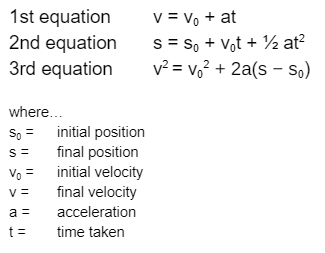
Three equations of motion are valid in most classical mechanics cases, along with a few assumptions such as the frame of reference should be stable,
acceleration of the object is constant, and the motion is a straight line.
The signs of the physical quantities should be the same if they move in the same direction and the opposite if they direct in different directions. It’s up to you to decide which way is positive or negative.
The universe as a whole is in motion. We live in a cosmos that is constantly changing. The atom, the fundamental particle of matter, is also in constant motion. Every physical process in the cosmos involves some form of motion. Motion might be fast or slow, but the motion is always present. Because of its relevance in the physical world, it is critical that we pay close attention to the study of motion. The motions of all big and known objects in the universe are described by Newton’s laws of motion such as projectiles, cars, cells, planets, and humans.


 Profile
 Settings
 Refer your friends
 Sign out