The Davisson-Germer experiment confirmed deBroglie’s earlier hypothesis by demonstrating the electron’s wave nature. It was a significant step forward in developing quantum mechanics because it established a firm experimental foundation for wave-particle duality. The Bragg diffraction law had been used before for x-ray diffraction, but this was the first time it had been used for particle waves.
Davisson and Germer designed and built a vacuum apparatus to measure the energies of scattered electrons from a metal surface. Electrons accelerated from a heated filament were allowed to strike a nickel crystal metal.
The electron beam was focused on a nickel target to study the angular dependence of scattered electrons. Their Faraday box electron detector was mounted on an arc and could be rotated to observe electrons from various angles. They were taken aback when they discovered that the intensity of the scattered electron beam had a peak at certain angles. Using this peak, which indicated electron wave behaviour, Bragg’s law could be used to calculate lattice spacing in the nickel crystal.
The experimental data above, which Davisson’s article, shows repeated peaks of scattered electron intensity as the accelerating voltage increases. This data was collected from a specific scattering angle. Using Bragg’s law, the de Broglie wavelength expression and the kinetic energy of the accelerated electrons are used to calculate the relationship.
Electron deflection and scattering by the medium are thus avoided.
The following are the main components of the experimental setup:
Diffraction gratings cannot diffract X-rays or de Broglie waves of electrons because their wavelengths (on the order of 10–10 m) are much shorter than light waves. X-rays and electron de Broglie waves have wavelengths comparable to the distance between atomic planes in a crystal. As a result, crystals that serve as three-dimensional gratings are used for diffraction.
The wavelength can also be calculated using the de Broglie equation (7.18) for V = 54 V.
This value is very close to the wavelength of 1.65 observed experimentally. As a result, de Broglie’s hypothesis about the wave nature of moving particles is directly confirmed by this experiment.
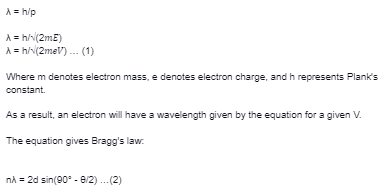
The de Broglie equation and Bragg’s law can be linked as follows:
We can deduce the following from the de Broglie equation:
X-ray diffraction experiments had already determined the value of d. As a result, we can find the wavelength of the waves that produce a diffraction pattern from an equation for various values of
In the above article, Davisson and Germer experiment is explained. This experiment confirmed deBroglie’s earlier hypothesis by demonstrating the electron’s wave nature. The experiment shows repeated peaks of scattered electron intensity as the accelerating voltage increases. This data was collected from a specific scattering angle.


 Profile
 Settings
 Refer your friends
 Sign out