In real life, we are surrounded by waves almost everywhere. WiFi, mobile networks, and several other wireless methods of communication consist of waves with different wavelengths. It was discovered that light has a wave nature by Sir Thomas Young’s experiments. Since so many physical events around us are mostly made up of waves, it has become extremely important to study the principle of superposition waves.
A wave is defined as a disturbance that travels and transports energy from the source to the receiver, but which cannot transport matter.
In physics, a wave is defined as a disruption or oscillation that flows across time and space, and its main function is to transfer energy. Wave motion transports energy from one location to another with negligible displacement that is not permanent.
The distance between two successive occurring crests of a wave in a sound or electromagnetic wave is called the wave’s wavelength.
The frequency of a wave is defined as the number of occurrences that happen per unit of time. To make the definition simple, the wave’s frequency is defined as the number of times the wave passes through one point in a unit of time.
The velocity of a wave is defined as the multiplication of the frequency and wavelength of the given wave. It is represented by ‘v’.
The height of a propagated wave is called the wave’s amplitude and is represented by ‘A’.
The principle of superposition of waves tells us that when two or more waves overlap in space, the net resulting disturbance is equal to the algebraic addition of the individual disturbances of the respective waves.
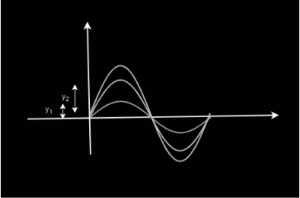
The diagram below depicts two waves that cause displacement in the particles of the specified medium. The principle of superposition asserts that in this circumstance.
When two or more waves, having an equal frequency and sharing a constant phase arrive simultaneously at a specific point, it is called interference of Light in Waves.
Interference of light in waves is separated into two categories, namely: constructive interference of waves and destructive interference of waves.
Suppose two waves overlay with one another in the same phase.
Suppose two waves overlay with one another in two different or separate phases.
Waves are an extremely important part of physics. The concept of waves helps us explain a wide range of physical phenomena such as light and matter, including atoms and electrons.
This topic is extremely important to help build the foundations of a student wanting to pursue a higher degree in Physics.
The main aim of this article is to impart knowledge related to the concept of the principle of superposition of waves and other various definitions related to different types of waves.


 Profile
 Settings
 Refer your friends
 Sign out