The force is said to be a natural existence or phenomenon that can cause a change in the motion or rest state of a body. Moreover, the force applied in the form of stress may cause a change in the dimension of the object. Hooke’s Law explained the principle of stress. According to this law, the stress imposed on a body will be directly proportional to the strain causing that body. Hooke’s law postulated the spring’s constant, in which the spring length is increased as much as the force is applied to stretch it. Therefore, the spring constant is also called the force constant.
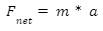
An object which has constant restoring force regardless of displacement. This is derived from Newton’s second law of motion, which states:
The force is equal to the product of the mass of the body to that of the acceleration produced in the body. Therefore, the acceleration of a body is directly proportional to that of the force applied over the body. i.e., the greater the force will be applied, the greater will be the acceleration produced in the body. On the other hand, with the increase in the mass of the body, there will be a decrease in acceleration.
A constant force is defined as the force applied in a constant manner on a particular object in a direction parallel to that of the direction of the acceleration produced in the body.
As stated earlier, the constant force is directly proportional to that of acceleration produced in a body. Moreover, the direction of the constant force will be in the direction of the acceleration.
This is justified by the formula given as:
Force applied= mass of the object X acceleration
When a physical quantity is equated with its dimensional formula, it is an expression that denotes the powers to which the fundamental units are raised to obtain a unit of a derived quantity.
In mechanics’ mass, length, and time are selected as three base dimensions from which other derived quantities such as velocity, force, energy are derived. The fundamental units are expressed as
Length expressed as ‘L.’
Mass expressed as ‘M.’
Time expressed as ‘T.’
Together they are represented as [ M L T]
Dimensional Formula of force
Force= mass x acceleration. Substituting this in the formula of force we get
F= M x M0L1T-2
Therefore,
F= M1L1T-2
Now computing the dimensional formula of force:
Derivation
Force Constant= Force × [Displacement]-1 . . . (1)
Since, Force = m × a
Therefore, The force is represented as, [M1 L1 T-2] . . . (2)
And, the displacement is represented as, [M0 L1 T0] . . . . (3)
Putting the value of equation (2) and (3) in the equation (1).
Force Constant= Force × [Displacement]-1
= [M1 L1 T-2] × [M0 L1 T0]-1 = [M1 L0 T-2].
Therefore, the dimensional representation of the constant force is,
[M1 L0 T-2]
The dimensional formula of force constant is given by,
[M1 L0 T-2]
Where,
A constant force is defined as the force applied in a concerted manner over an object. At the same time, the direction of the constant force is parallel to that of the direction of the acceleration produced in the body. However, the work done by a constant force is denoted by the product of the acceleration produced in the body as well as the force applied on the body.
It is denoted by W = F.d.
It is equal to the force’s magnitude multiplied by the distance the item travels in the force’s direction.


 Profile
 Settings
 Refer your friends
 Sign out