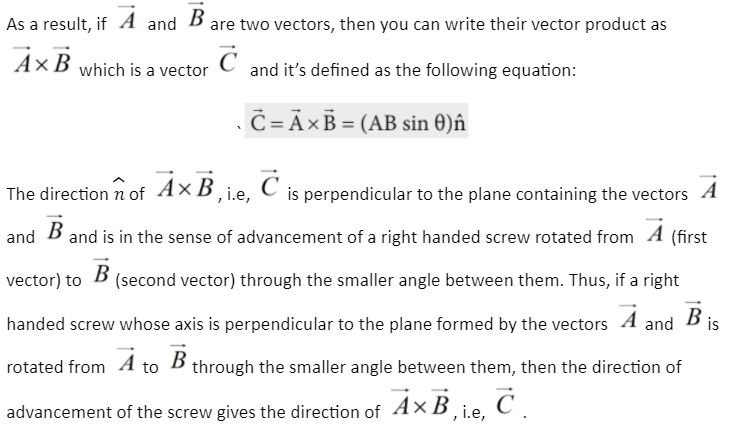
The vector product, also known as the two vectors’ cross product, is a new vector with a magnitude equal to the product of the magnitudes of the two vectors into the sine of the angle between these. If you use the right-hand thumb or the right-hand screw rule, the direction of the product vector is parallel to the direction that has the two vectors in it.
When two vectors are crossed, they are multiplied by each other. The sign (x) denoting a product (cross) is placed between two vectors. It is a three-dimensional binary vector operation. A third vector, which lies in the perpendicular direction of two originals, is formed by taking the two original vectors’ cross product. The parallelogram’s area is the one that connects them determines its magnitude, and the rule of the right-hand thumb can be used to calculate its direction. Because the cross-product of vectors gives rise to vector quantities, it’s sometimes referred to as a “vector product”. The two vectors’ cross product is the subject of today’s lesson.
A few key points of cross products:
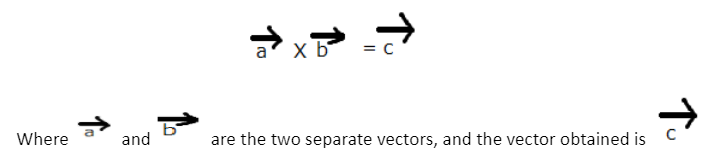
For example, if there are vectors (two) that lie in a plane (X-Y), their cross product will produce a vector obtained in the Z-axis’s direction, which is perpendicular to the XY plane. Between the vectors that are original, we use the x symbol. The product of the vector often referred to as the cross product of these two vectors, looks like this:
The following are some essential considerations:
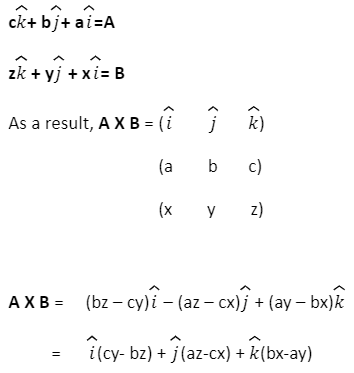
If we take two vectors, for instance:
For instance, there are A and B, which are a couple of vectors, then the diagram for the rule of right-hand thumb looks like this:
We may utilise properties to find the two vectors’ cross-product. To obtain the two vectors’ cross product, features such as anti-commutative property and zero vector property are important. Other properties include the Jacobi property and the distributive property, among others.
The following are the properties of cross-product:
(i) The two vectors’ cross product has a length equal to:
→ →
a × b = |a||b|sin(θ)
(ii) The property of anti-commutative is:
→ → → →
a× b= −b × a
(iii) The Distributive property is:
→ → → → → → →
a × (c + b) = ( a × b )+ ( a × c)
(iv)The zero vector’s cross product:
→ → →
a × 0 = 0
(v) The vector’s cross product with itself:
→ → →
a × a = 0
(vi) When a quantity (scalar) is multiplied, the result is:
→ → → → → → →
c (a × b)= (c a) × b = a × ( cb)
(vii)The unit vectors’ cross product is:
→ → → → → →
i × i = j × j = k × k = 0
We have learned about the vector product, cross vector, its properties, and the right-hand rule with different examples and formulas. Here are a few key pointers to keep in mind:
→ →
a and b; the original two vectors.


 Profile
 Settings
 Refer your friends
 Sign out