The Triangle is one of the crucial aspects of mathematics. The modern expression of the triangle can be well referenced from the Latin word “triangulus” or “three-cornered”. They also constitute the pillars of geometry, trigonometry, Euclid’s laws, and various other components of Mathematics.
Triangles are a type of polygon having three sides and three angles or vertices that depend on the type of the polygon. Each triangle fundamentally consists of three edges, three angles and all of the edges intersecting each other at three vertices. The triangle is a two-dimensional geometrical figure responding to the Euclidean plane. Triangles are vital for mathematical study and triangle type use and applications have developed further.
The interesting properties of triangles and their types helps us the relationship between different sides and angles. These crucial elements of triangles also help us understand the association of triangular properties and types of the triangle with other aspects of geometry and understand connections with other mathematical components.
The sum of all the interior angles of a triangle is not more than 180 degrees. This property of a triangle helps us simply understand the essentials of drawing a triangle, identifying the basic angle sum property helps us also use its application on finding the edges of a triangle, for example, the three angles of a triangle are P, Q and R then the property follows that: ∠P + ∠Q + ∠R= 180°.
As per the triangle inequality theorem, the cumulative of the measurements of any two edges of a triangular polygon is more than the measurement of the final side. Hence, if we consider a triangle having sides namely a, b and c with measurements of four units, six units, and three units respectively.
Hence the triangle ABC would provide us with the following conclusions:
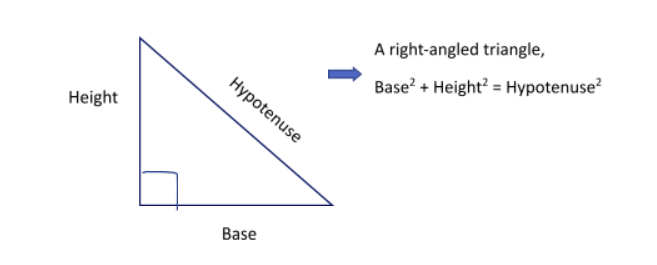
The most vital fact to apply this property is to understand that this property is only applicable for right-angle triangles i.e., the triangles having one of the vertices bearing an angle of 90 degrees. Also, the underlying side of the right angle is termed as a base and the associating side of the right angle is termed as height. Hence the conclusion of this property gives us an equation of Pythagoras theorem as Base² + Height² = Hypotenuse². This property also divides the right-angle triangle into a specific triangle type.
The property says that the sum of the opposite interior angles is equal to the exterior angle of the corresponding part of the considered interior angle. Further to also be aware of the fact that the sum of the exterior angles of each interior angle is always equal to 360 degrees. Both the exterior angle and Pythagoras property also helps distinct types of triangles.
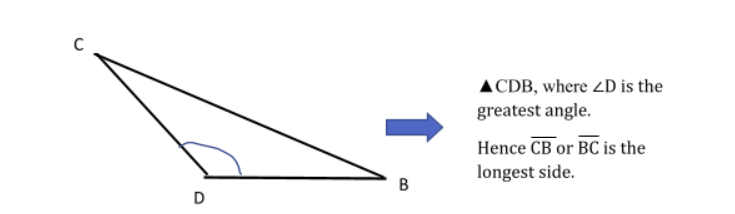
Assuming a triangle CDB in which angle D is the greatest angle among the other than the side opposite to the angle will be side BC or CB. Hence the side CB can also be termed as the longest side.
Triangles can be classified into various triangle types based on their angles and sides. The classification of types of triangles helps us identify and get well briefed about the vivid applications and their roles in further geometric and mathematical applications.
The uses and insights of triangular properties and types of triangles can be ranging from ancient pyramids to modern-day bridges, architectures, and developing the fields of mathematical and geometrical knowledge. The article mainly focuses on helping us understand the vivid triangular properties and triangle types, also trying to clear additional queries through the frequently asked questions segment.


 Profile
 Settings
 Refer your friends
 Sign out