This easy-to-understand and well-written article aim to help grasp the concepts of analytical geometry, the three dimensions (or 3D) in analytical geometry, and the three dimensions – various forms of eq. of line.
To represent or find the equation in any line or 3D space, the knowledge of 3D coordinates (or analytical) geometry is required.
The vector and cartesian forms make up the three dimensions – various forms of eq. of line.
The equation of a line in –
Vector form: r->= a-> + λ d-> and r->= a->+ λ (b-> – a->)
Cartesian form:
(x – x1) / (x2 – x1) = (y – y1) / (y2 – y1) = (z – z1) / (z2 – z1), and
(x – x1) / a = (y – y1) / b = (z – z1) / c.
There are two cases of representing the equation of a line in vector form.
Case 1 is the equation of a line passing through a point whose position vector is a-> and parallel to d->.
Case 2 is the equation of a line passing through two points whose position vectors are a-> and b->, respectively.
Case 1 is the equation of a line passing through two points whose coordinates are (x1, y1, z1) and (x2, y2, z2). It is also the standard equation of a line in three-dimensional space.
Case 2 is the equation of a line parallel to the vector a î + b ĵ + c kˆ, and passing through a point whose coordinates are (x1, y1, z1).
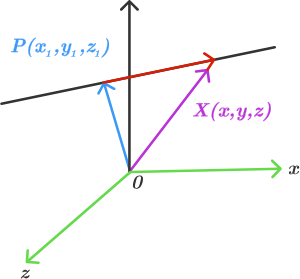
Considering a line that passes through the point P (x1, y1, z1) and whose direction vector is d->= (a, b, c).
Here, a, b, and c are non-zero real numbers.
Assuming A = (x, y, z) as a random point on the given line.
Consider the figure below:
From the figure, we can see that the arrow represents the vector P->X and is parallel to the vector d->.
We can write,
P->X = t d->.
Hence, we can conclude that any point A = (x, y, z) on the line will satisfy the following equation:
(x – x1)/a = (y – y1)/b = (z – z1)/c.
Through this article, we have understood and grasped the concepts of analytical geometry, three dimensions (or 3D) in analytical geometry, and three dimensions – various forms of eq. of line in analytical geometry.
In the three-dimensional coordinate system, the coordinates of point A are represented as A (x, y, z), and the vector form and cartesian form make up the three dimensions – various forms of eq. of line.
They now know that (x – x1) / (x2 – x1) = (y – y1) / (y2 – y1) = (z – z1) / (z2 – z1) is the standard equation of a line in three-dimensional space.


 Profile
 Settings
 Refer your friends
 Sign out