A term that expresses an activity or a situation of being is defined as a verb. Most verbs are crucial to the sentence’s predicate and provide important details about the sentence’s topic. A verb is always “performing” something, whether it’s physically doing an action in a sentence or simply relating the subject to the rest of the information. Verbs are sentence’s busybodies, serving to create a complete thought to a close. They are also referred to as action words.
There are numerous forms of English verbs. The word sing, for example, can have verb form as sang, sung, singing, sing, or sings. There are a total of 5 verb forms in this set. Some languages, such as French, have more than 30 forms for a single verb. Although English tenses are complex, the forms we employ to create them are actually rather straightforward. Except for the word be, English major verbs only have three, four, or five forms. There are eight different verb forms of Be. Because most helping verbs do not change, they have even fewer forms.
With major verbs, we use auxiliary verbs, also called helping verbs. There are two types of helping verbs:
To change the tense or voice of the main verb, as well as to construct inquiries and negatives, we employ major helping verbs. Do, have, and we are the only three major helping verbs. These verbs can be used as primary verbs as well. Here are the forms we use when we utilize them as helping verbs:
Base verb Form | Simple Present Verb Form (3 Verb Forms) | Simple Past Verb Form (2 Verb Forms) | Present Participle Verb Form | Past Participle Verb Form |
be | am are is | was were | being | been |
Here are some example sentences of using the major helping verbs with main verbs
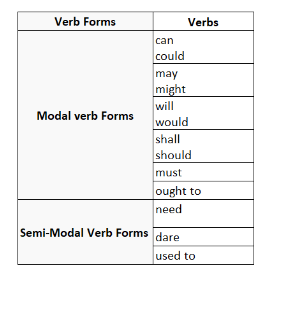
To vary the feeling of the main verb, we utilize modal helping verbs. As you can see, each modal verb has only one form. They’re never going to change.
1.Action verb examples are
2.Transitive verb examples are:
3.Intransitive verb examples are:
4.Auxiliary verb examples are
5.Irregular verb examples are
6.Modal verb examples are:
The words that describe a noun or modify a pronoun are called adjectives. Some of the Adjectives’ examples are as follows:
The English language relies heavily on verbs or the action words. Sentences would be meaningless without them. There are numerous types of verbs used throughout the English language. There are sample phrases also which help in a better knowledge of what they are. As discussed we should remember verb forms, their examples, purposes and rules to avoid any mistake in spoken or written communication.


 Profile
 Settings
 Refer your friends
 Sign out